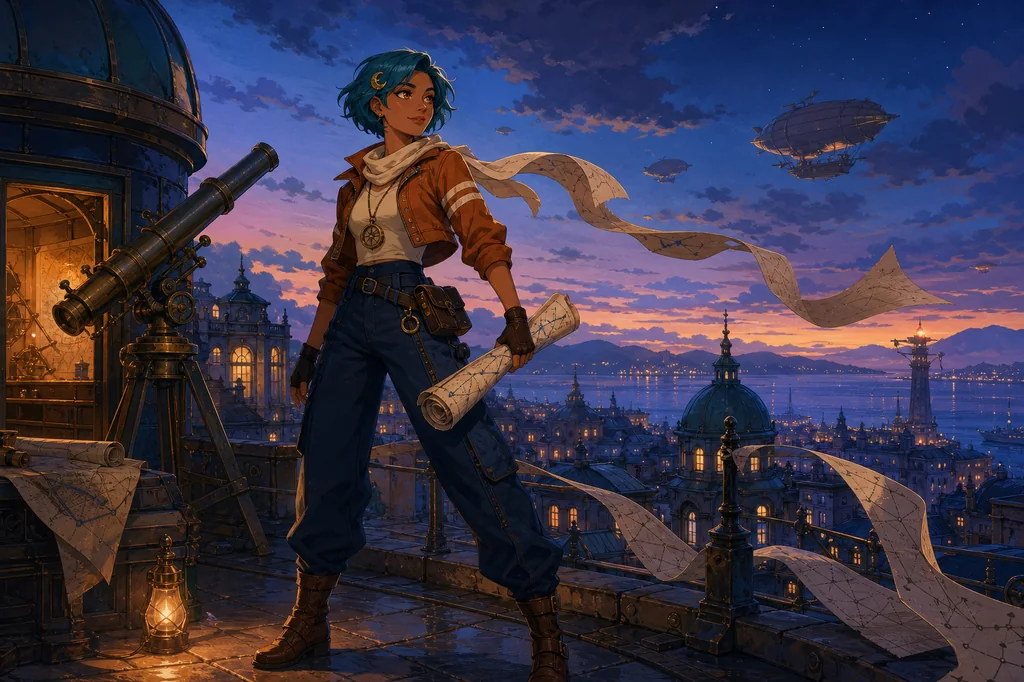
The hard part of AI animation is not producing one attractive character image. It is keeping the same face, costume, accessories, physical weight, and personality when the character runs, turns, and appears in close-up. This guide extends beyond a character sheet and connects still-image design, image-to-video generation, and shot continuity in one production workflow.
OpenAI documents multi-image reference workflows for image generation and editing. Runway's current image-to-video guide says the input image already establishes subject, composition, lighting, and style, so the text should focus on motion. Google's video prompt guide separates subject, action, camera angle, and camera movement, while Adobe Firefly can use first and last frames as anchors. The shared principle is simple: lock appearance with images and describe change over time with the video prompt.
Production workflow
| Stage | Core deliverable | Prompt focus | Pass condition |
|---|---|---|---|
| 1. Character bible | Turnaround and expressions | Face, proportion, costume invariants | Every view is the same person |
| 2. Motion design | Five key poses | Contact, weight, silhouette | The action reads without captions |
| 3. Keyframes | Start and end images | Camera, axis, light, space | Both frames can belong to one shot |
| 4. Video generation | One short action shot | Subject, environment, camera motion | Intent and physical contact survive |
| 5. Edit and review | Continuity board | Screen direction, color, accessories | Identity and geography connect across cuts |
The example uses Mira, an original adult sky-cartographer unrelated to any existing franchise: warm brown skin, a short asymmetrical teal bob, a crescent gold hair clip at her left temple, a burnt-orange flight jacket, cream scarf, and brass compass pendant.
Cover image production prompt
Use case: stylized-concept
Asset type: landscape blog thumbnail for a guide about creating consistent animation character images and image-to-video shots
Primary request: create a polished original animation key art featuring one adult female sky-cartographer named Mira preparing for an animated rooftop chase, visually communicating character design plus motion planning
Scene/backdrop: twilight rooftop observatory above a luminous coastal city, brass telescope, wind-driven map ribbons, distant airships, layered foreground midground and background
Subject: one original adult woman, athletic slender build, warm brown skin, short asymmetrical teal bob haircut, amber eyes, small crescent-shaped gold hair clip over her left temple, cropped burnt-orange flight jacket with two ivory sleeve stripes, navy high-waisted utility trousers, cream scarf, brown ankle boots, round brass compass pendant; determined but warm expression; she stands in a readable three-quarter action-ready pose holding a rolled star map
Style/medium: premium hand-painted 2D animation concept art, clean cel shapes with subtle gouache texture, expressive silhouette, production-ready visual development, original design not based on any existing franchise or artist
Composition/framing: 3:2 landscape, full character visible slightly off-center, cinematic wide-medium framing, strong diagonal rooftop lines and generous breathing room, readable silhouette suitable for a blog cover
Lighting/mood: blue-hour sky, warm amber observatory lamps, soft rim light on teal hair and orange jacket, adventurous and hopeful
Color palette: teal, burnt orange, deep navy, warm brass, violet-blue sky
Materials/textures: painted metal, worn leather, soft scarf fabric, paper map, restrained hand-painted texture
Constraints: exactly one main character; preserve clear face, hands, costume construction, pendant and hair clip; no text, no letters, no logos, no watermark, no UI, no copyrighted characters, no imitation of a living artist
Avoid: photorealism, 3D render, chibi proportions, childlike appearance, extra limbs, duplicated character, unreadable face, cropped feet
1. Build the character bible from observable features
“A cool female explorer” leaves the model room to redesign her in every scene. Define visible anchors: facial geometry and adult age, hair silhouette, the side of an asymmetric accessory, costume seams, and color placement. Use equal-scale front, three-quarter, strict side, and back views under neutral light. Expressions should change facial muscles, not identity.
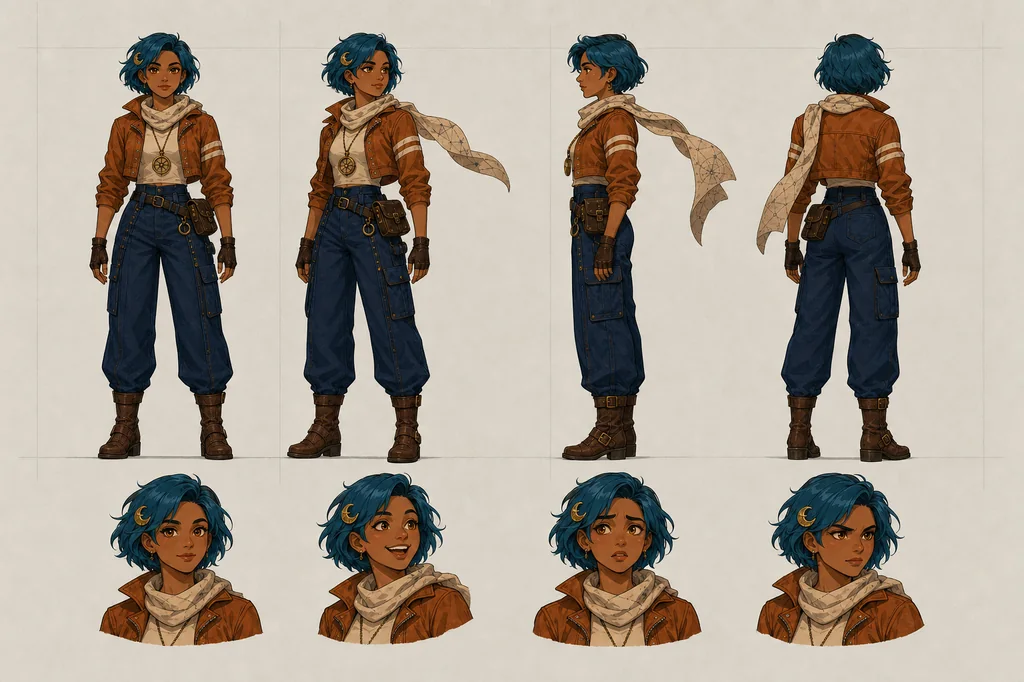
Image production prompt — character reference sheet
Use case: identity-preserve
Asset type: landscape blog illustration showing an animation character reference sheet
Input images: Image 1 is the identity and costume anchor for Mira; preserve her exact adult identity and design
Primary request: create a clean production character sheet for the same original adult female sky-cartographer Mira, showing consistent front, three-quarter front, strict side, and back full-body views plus four small head expression studies: neutral, delighted, worried, determined
Scene/backdrop: warm light-gray studio paper background with faint registration-grid lines only, no labels
Subject: preserve the same warm brown skin, short asymmetrical teal bob, amber eyes, crescent gold hair clip over left temple, cropped burnt-orange flight jacket with two ivory sleeve stripes, navy high-waisted utility trousers, cream scarf, brown ankle boots, round brass compass pendant and map satchel; equal body proportions and costume seams in every view
Style/medium: same premium hand-painted 2D animation visual development style as Image 1, clean cel shapes, subtle gouache texture, production-ready model sheet
Composition/framing: 3:2 landscape, orthographic lineup with equal-scale uncropped full-body views and a separate balanced row of head expressions, generous spacing, all feet aligned to one ground line
Lighting/mood: flat even studio lighting, neutral material colors, restrained shadows
Color palette: exact teal, burnt orange, navy, cream and brass palette from Image 1
Constraints: do not redesign the character; preserve facial geometry, apparent adult age, body proportions, handedness, hair clip side, pendant, jacket stripes, scarf, boots and satchel; no text, no letters, no numbers, no logos, no watermark, no UI, no perspective distortion
Avoid: dramatic camera angle, environment scene, duplicate limbs, cropped figures, inconsistent clothing, chibi proportions, childlike appearance, photorealism, 3D render
Zoom in and compare the hair-clip side, sleeve-stripe count, pendant, satchel placement, height, and leg proportions. If any anchor drifts, repair the reference before making scene images. One approved reference is better than several contradictory ones.
2. Design key poses before asking for in-betweens
Generating “run and jump” directly often produces sliding feet or a body that changes in midair. First design anticipation, push-off, apex, landing contact, and recovery. Each pose should read as a silhouette, while pelvis and rib-cage direction, support foot, and center of mass explain the action.
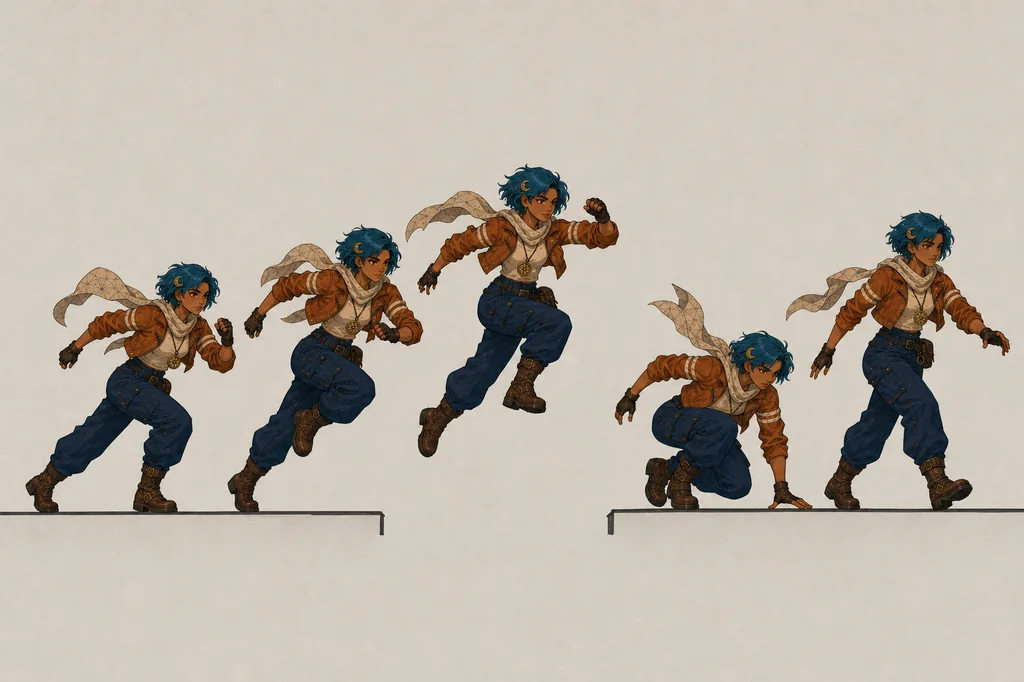
Image production prompt — jump key poses
Use case: identity-preserve
Asset type: landscape blog illustration showing animation key-pose planning
Input images: Image 1 is Mira's approved production character sheet; preserve the exact identity, proportions, costume construction, colors and handedness
Primary request: create a clean five-pose animation key-pose board for the same adult sky-cartographer running, jumping across a narrow rooftop gap, landing, and recovering balance; show anticipation, push-off, airborne apex, contact, and recovery as distinct readable poses
Scene/backdrop: minimal pale warm-gray studio background with one simple dark rooftop ground line and a narrow gap, no environment detail and no labels
Subject: the same adult Mira with warm brown skin, short asymmetrical teal bob, amber eyes, crescent gold hair clip on left temple, burnt-orange cropped flight jacket with two ivory sleeve stripes, navy utility trousers, cream scarf, brown boots, brass compass pendant and satchel; the scarf, jacket hem, hair tips and satchel show secondary motion that follows each pose
Style/medium: matching premium hand-painted 2D animation concept art, clean cel shapes, subtle gouache texture, production key-pose sheet
Composition/framing: 3:2 landscape, five full-body poses arranged left to right at equal scale, complete uncropped figures, consistent ground line and clear arcs of action, generous spacing
Lighting/mood: flat even studio lighting, clear silhouettes, no dramatic shadows
Color palette: exact teal, burnt orange, navy, cream and brass palette from Image 1
Constraints: do not redesign the character; preserve face, apparent adult age, body proportions, clothing seams, hair clip side, pendant, scarf and satchel; mechanically plausible weight shift and foot contact; no text, no letters, no numbers, no arrows, no logos, no watermark, no UI
Avoid: duplicate limbs, fused hands, floating feet except airborne pose, inconsistent costume, cropped figures, motion blur, photorealism, 3D render, childlike proportions
The scarf, hair tips, jacket hem, pendant, and satchel should not move in perfect sync with the torso. Plan delayed secondary motion: the body accelerates first, soft elements follow, and they continue settling after landing.
3. Treat first and last frames as anchors of one shot
Two beautiful images may still be impossible to interpolate if camera height, lens, horizon, light, or screen direction changes. Match character scale, travel direction, and the target object, then request only the action that can plausibly connect them. Tools such as Adobe Firefly can use the two images directly as fixed points.
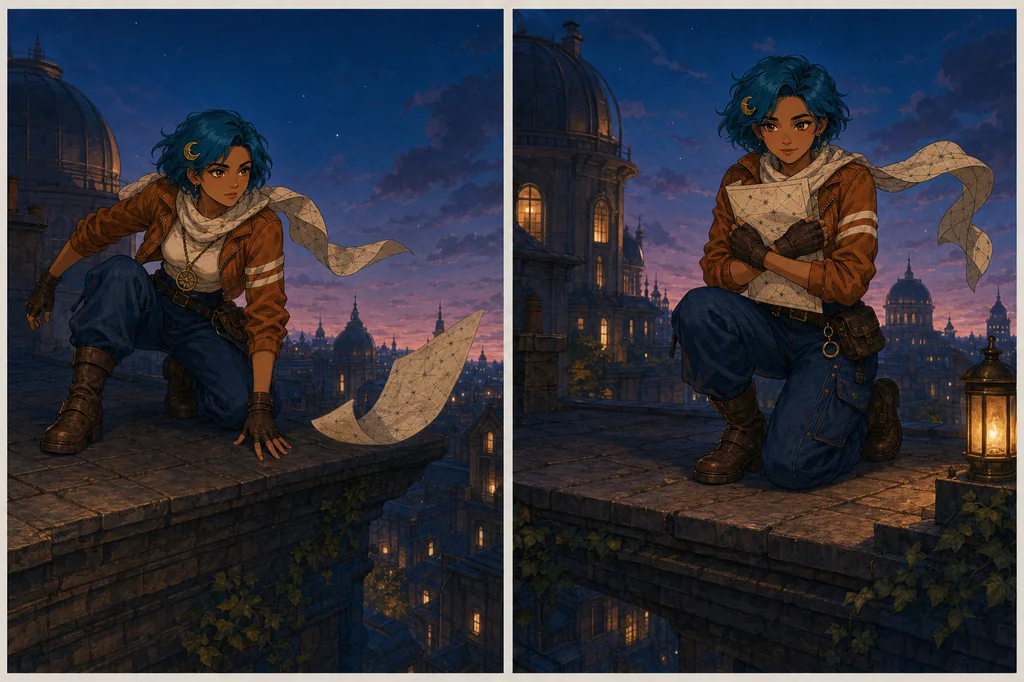
Image production prompt — first and last keyframes
Use case: identity-preserve
Asset type: landscape blog illustration comparing first and last keyframes for image-to-video animation
Input images: Image 1 is Mira's approved production character sheet; preserve the exact adult identity, proportions, costume, colors, and handedness
Primary request: create a coherent two-panel cinematic keyframe pair for one continuous rooftop action shot; left panel is the starting frame with Mira crouched on the near rooftop, eyes locked on a loose star map beginning to lift in the wind; right panel is the ending frame with the same Mira safely on the next rooftop, one knee down, firmly catching the same map against her chest, relieved focused expression
Scene/backdrop: the same twilight rooftop observatory city in both panels, matching horizon, architecture, blue-hour sky, warm lamps and wind direction; the roof gap and destination are spatially coherent
Subject: same original adult Mira with warm brown skin, short asymmetrical teal bob, amber eyes, crescent gold hair clip over left temple, burnt-orange cropped flight jacket with two ivory sleeve stripes, navy utility trousers, cream scarf, brown boots, brass compass pendant and satchel
Style/medium: premium hand-painted 2D animation keyframe art matching the approved sheet, clean cel shapes, subtle gouache texture
Composition/framing: 3:2 landscape divided into two equal cinematic panels with a narrow neutral gutter, matching eye-level wide-medium lens and character scale, no border labels; readable start-to-end screen direction from left to right
Lighting/mood: blue-hour ambient light with consistent warm amber rim and lamp accents, adventurous tension resolving into relief
Color palette: exact teal, burnt orange, navy, cream, brass and violet-blue palette from Image 1
Constraints: do not redesign character or environment between panels; preserve facial geometry, adult age, costume seams, hair clip side, pendant and satchel; same camera height, lens, horizon and light direction; no text, no letters, no numbers, no arrows, no logos, no watermark, no UI
Avoid: unexplained costume change, mirrored hair clip, extra characters, duplicated limbs, cropped body, photorealism, 3D render, childlike appearance, motion blur
4. Write image-to-video prompts about motion, not appearance
A strong starting frame already supplies face, costume, background, and composition. Repeating them at length can invite reinterpretation. Describe three direct layers instead:
- Subject motion: gaze, anticipation, foot contact, weight transfer, and hand objective
- Environmental motion: wind direction and the response of paper, cloth, and hair
- Camera motion: one primary path—locked, truck, dolly, or pan—and its speed
Choose duration in the service controls rather than writing it into the prompt. Complete one action per shot; for a longer sequence, reuse the approved last frame as the next shot's input.
Video production prompt — first frame only
The sky-cartographer drives forward from her crouch and accelerates toward the roof gap. She plants her lead foot, compresses her body, then pushes into one clean jump. Her cream scarf, short teal hair, jacket hem, compass pendant, and satchel follow the motion with delayed secondary movement. The loose star map lifts and tumbles ahead in the same wind direction. The camera trucks smoothly to the right at her running speed, holding a medium-wide side profile and a stable horizon. She lands with visible weight, absorbs the impact through one knee, reaches forward, and secures the map. Continuous seamless shot, coherent anatomy, physically plausible contact and momentum.Video production prompt — first and last frames
Animate one continuous left-to-right rooftop action between the supplied first and last frames. Mira focuses on the airborne map, rises from the crouch, runs three decisive steps, jumps the narrow gap, lands with compressed weight, then catches the map against her chest and settles into the final kneeling pose. Her scarf, hair tips, jacket hem, pendant, and satchel trail and settle after the body. The map follows the established wind. The camera performs a smooth lateral truck with restrained parallax; keep the horizon, architecture, blue-hour light, costume construction, facial identity, and screen direction consistent. No cut or viewpoint change.Runway recommends focusing image-to-video text almost entirely on motion. If a shot fails, add only one of subject, environment, or camera detail at a time. Strong motion blur or cloth already flying opposite the intended direction in the input image can conflict with the prompt.
5. Review continuity as a board, not a single frame
A costume that looks correct in a wide shot may mutate in close-up, and travel direction can reverse across a cut. Extract start, middle, and end frames from candidate clips and compare the establishing, tracking, close-up, and landing shots together.
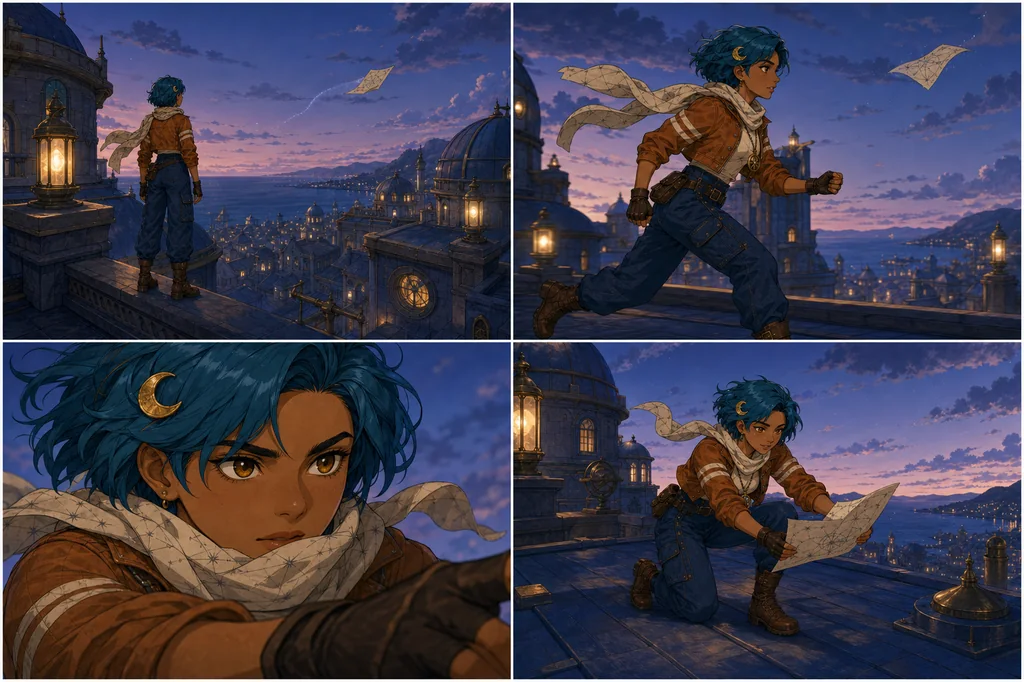
Image production prompt — shot continuity board
Use case: identity-preserve
Asset type: landscape blog illustration showing animation shot-continuity review
Input images: Image 1 is Mira's approved production character sheet; preserve exact adult identity, proportions, costume construction, colors and handedness
Primary request: create a polished four-panel storyboard contact sheet from one continuous rooftop sequence: panel one is a wide establishing shot of Mira spotting the airborne star map; panel two is a side medium tracking shot as she runs; panel three is a close-up of her focused eyes and wind-tossed teal hair; panel four is a wide landing shot as she catches the map on the next roof
Scene/backdrop: one coherent twilight observatory district above a coastal city, same roof materials, domes, lamp design, horizon, wind direction and blue-hour time across all panels
Subject: the same original adult Mira with warm brown skin, short asymmetrical teal bob, amber eyes, crescent gold hair clip over left temple, burnt-orange cropped flight jacket with two ivory sleeve stripes, navy utility trousers, cream scarf, brown boots, brass compass pendant and satchel
Style/medium: premium hand-painted 2D animation storyboard key art, clean cel shapes, subtle gouache texture, matching the approved character sheet
Composition/framing: 3:2 landscape, four equal cinematic panels in a clean 2x2 contact sheet with narrow neutral gutters, clear left-to-right screen direction and coherent eyelines, each panel readable at thumbnail size
Lighting/mood: consistent blue-hour ambient light and warm amber lamps, energetic adventure with a satisfying finish
Color palette: exact teal, burnt orange, navy, cream, brass and violet-blue palette from Image 1
Constraints: preserve face, apparent adult age, hair clip side, jacket stripes, scarf, pendant, satchel, boots and body proportions in all panels; coherent geography and continuity; no text, no letters, no numbers, no arrows, no logos, no watermark, no UI
Avoid: character redesign, mirrored accessories, costume color drift, extra characters, duplicate limbs, unexplained camera-axis reversal, photorealism, 3D render, childlike proportions| Failure signal | Common cause | Repair order |
|---|---|---|
| Face changes mid-shot | Reference is small or contradictory | Approved face crop → regenerate one shot |
| Accessory switches sides | Mirroring and vague direction | State asymmetric side → fix that cut |
| Feet slide | Contact and weight omitted | Lock support foot and landing pose |
| Camera suddenly cuts | Multiple shots in one prompt | Split into one continuous shot |
| Background melts | Weak spatial anchors | Lock horizon, architecture, and light in keyframes |
| Hair and cloth move backward | Wind conflicts with inertia | Set one wind direction and delayed secondary motion |
Pre-publish checklist
- The character does not imitate a real person or copyrighted character.
- Face, adult age, hair, and costume construction match across every reference view.
- Contact, center of mass, and objective are readable in every key pose.
- Camera, horizon, light, and screen direction connect between first and last frames.
- The video prompt prioritizes subject, environment, and camera motion over appearance.
- Face, hands, asymmetric accessories, costume boundaries, and background geometry are inspected frame by frame.
- Current platform terms, input-image rights, and commercial-use conditions have been checked.
Conclusion
Consistent AI animation does not come from one giant prompt. It comes from a chain: images that lock identity, poses that explain motion, compatible first and last frames, a video prompt limited to one action, and human frame review. Restarting only the failed shot from the latest approved frame is usually more controllable than regenerating an entire sequence.
Sources
- OpenAI — Image generation guide
- Runway — Image to Video Prompting Guide
- Google Cloud — Video generation prompt guide
- Adobe Firefly — Generate videos using Firefly models
Generation features and controls change. Obtain explicit consent and the necessary rights when using a real person's face or voice, and inspect results frame by frame before publication.