Explore AI by category
Compare carefully selected
AI tools at a glance.
EXPLORE THE AI WORLD
Find, compare, and start using
the right AI tools.
Compare carefully selected
AI tools at a glance.
Compare an independent intelligence index with cost per benchmark task, including token usage.
Representative reasoning setting per model · higher is better
Important changes in the world of AI
NVIDIA announced expanded work with the Korean government, companies, and universities on AI infrastructure, physical AI, agent research, and a roughly 100,000-GPU plan at NAVER’s Sejong data center.
Meta is rolling out planning, email and calendar connections, recurring tasks, deep research, and slide creation in Meta AI powered by Muse Spark 1.1.
GitHub is gradually adding Anthropic’s Claude Opus 5 to Copilot development environments and its cloud agent for complex, long-running coding work.
The UK government created a Prime Minister’s AI Taskforce to coordinate national AI strategy and public-sector transformation, appointing Lord Patrick Vallance as chair.
Researchers introduced VLM-IE3D, which learns implicit and explicit geometry from RGB video to improve spatial reasoning without separate 3D input.
Search by a task or keyword
Practical ideas for understanding and using AI
A quick reply is not a finished task. Design voice agents that report real progress, handle interruptions, confirm cancellation and verify results.
Genie, Marble, Atlas, and Cosmos explained: compare interactive frames, reusable 3D spaces, and action prediction to choose a workflow for your next project.
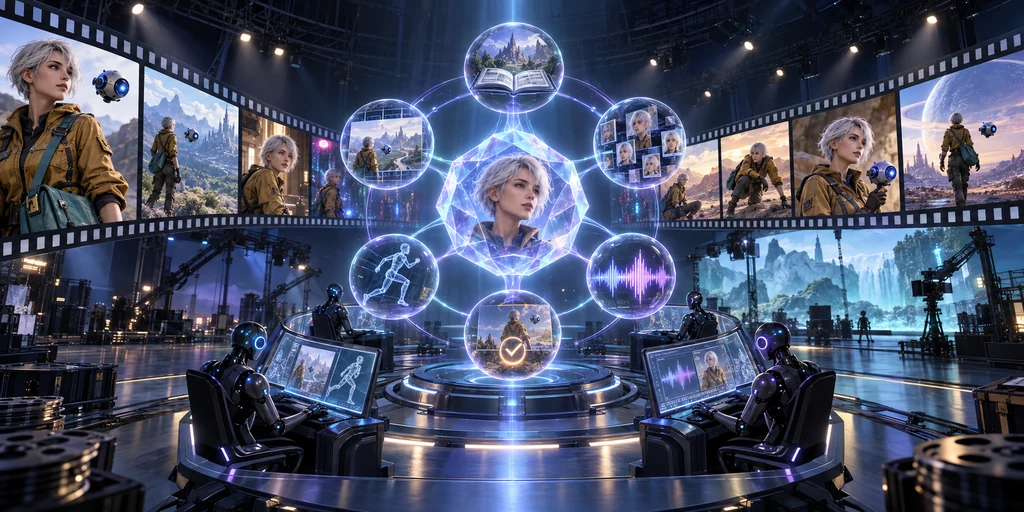
A practical analysis of why strong clips fail to become coherent films—and how global planning, visual memory, segment generation, and question-based review change the workflow.
Copy and adapt prompts for agents, images, video, and everyday work.
Separate speech interruption from task cancellation and design dialogue policies and simulated checks grounded in real task evidence.
Add reproducible fixtures, state checks and a test runner to existing NPC code to expose memory leaks, broken branches and duplicate rewards.
Specify object counts and edit regions, protect existing objects and layout, and create a copy-ready edit prompt with evidence-based QA.
Design subtle breathing, gaze, and weight shifts, then review pose, motion continuity, and contacts at the repeat boundary.
Separate character voice and hidden intent, create meaning-preserving line alternatives, and prepare an ADR cue sheet for read-through checks.
Link media originals, derivatives, usage terms, and permission evidence; flag unknowns and prepare checks before publication.