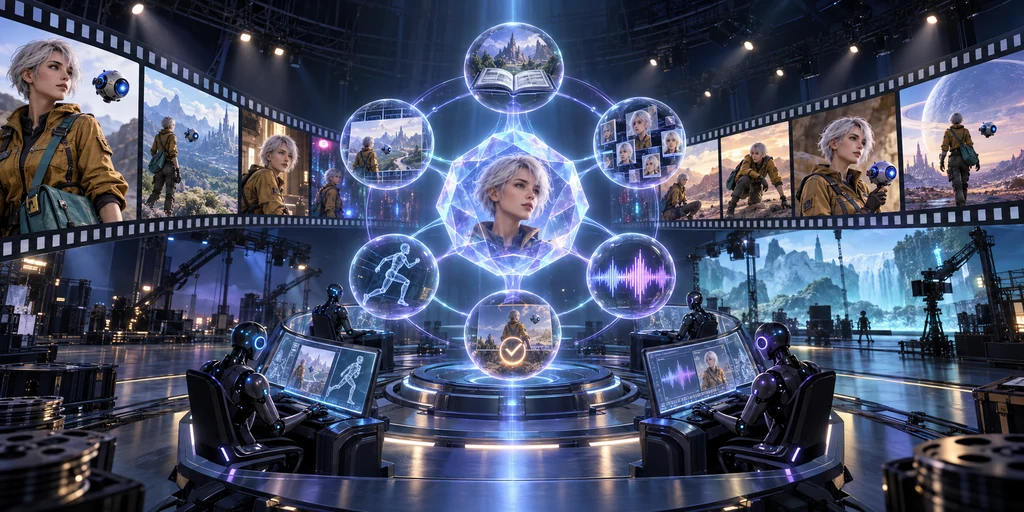
AI video models can produce astonishing short clips. Connect several shots, however, and the same character changes clothes, a prop disappears, or a revisited room acquires a different layout. Each clip may look impressive while the story as a whole gradually collapses.
On September 24, 2026, Google Research presented a group of projects that reframes this as a problem of global planning, world state, long-term visual memory, and iterative evaluation, not simply a contest for a stronger base model. The proposed system divides directing, storyboarding, keyframes, video, audio, and review among coordinated agents, then checks the result against the complete creative intent.
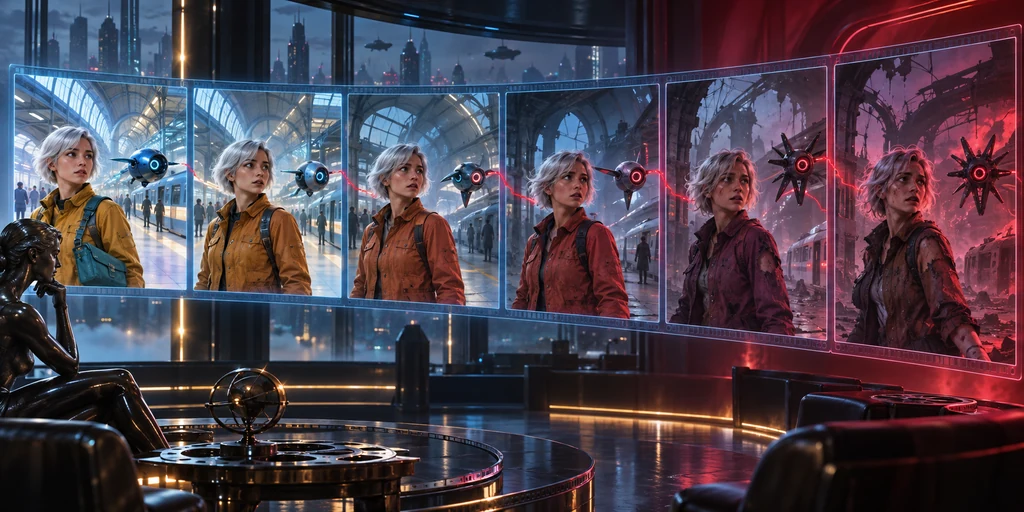
A good shot and a coherent film are different objectives
A linear workflow usually turns a script into images, images into clips, and clips into a timeline. A small early mistake becomes input to every later stage. When the final cut fails, it is difficult to assign responsibility to the exact prompt or asset that caused it.
| Failure | Visible symptom | Structural cause |
|---|---|---|
| Identity drift | Face, clothing, or body changes | Every shot reinterprets the person |
| Spatial drift | Doors, windows, and paths move | No persistent location state |
| Prop-state error | An object vanishes or duplicates | State before and after an action is not tracked |
| Narrative collapse | Motion continues but the plot does not | Local clips are optimized in isolation |
| Cascading failure | A bad keyframe contaminates later clips | Too few review and rollback points |
Longer prompts alone do not solve this. Repeating the entire world bible for every shot creates conflicts and buries the invariants. A production needs an explicit state model that distinguishes what must remain fixed from what is allowed to change.
Four projects address four different bottlenecks
Google presents four research efforts as parts of one production architecture. Co-Director and CANVAS are described as forthcoming at COLM 2026 and EMNLP 2026; A²RD and VQQA are arXiv studies. Their results should therefore be read as author-reported research findings, not product guarantees or independent replications.
| Component | Problem | Mechanism | Practical lesson |
|---|---|---|---|
| Co-Director | Whole-project direction | Global search over strategy, narrative, and aesthetics | Lock the creative contract before shots |
| CANVAS | Character, location, and prop continuity | Persistent visual memory and world state | Keep separate identity, space, and prop ledgers |
| A²RD | Long-horizon progression and return | Retrieve, synthesize, refine, update | Separate new progression from re-anchoring |
| VQQA | Finding and repairing defects | Visual questions and global candidate selection | Select the best version, not merely the last |
Co-Director chooses a high-level creative strategy, narrative mode, and aesthetic direction so downstream production agents share one intent. A multimodal judge scores the compiled result and feeds a factored signal back into the next search. The paper evaluates this structure with GenAD-Bench, a set of 400 fictional advertising scenarios.
Visual memory must be more precise than a reference folder
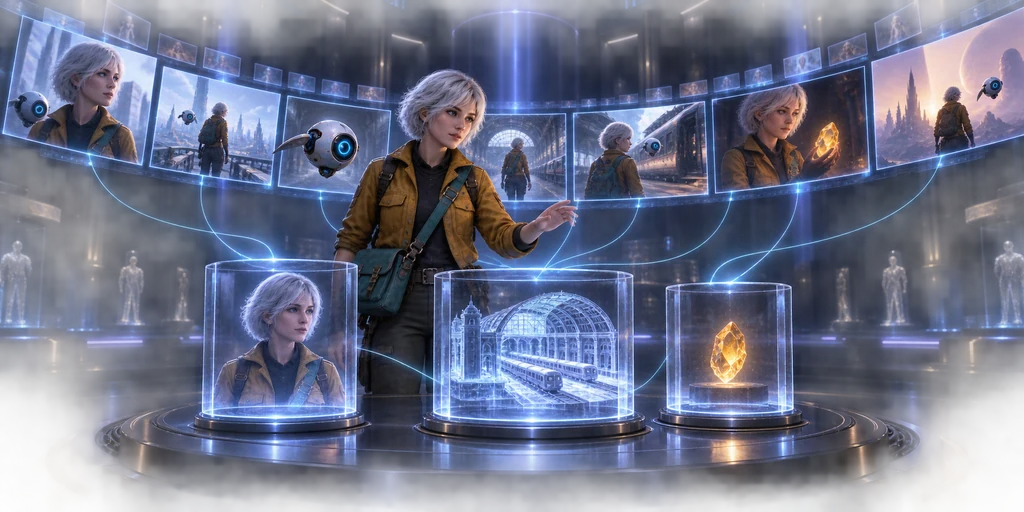
CANVAS structures characters, locations, and objects, retrieving visual anchors when a story revisits them. The paper reports gains over its strongest baseline of 21.6% for background continuity, 9.6% for character consistency, and 7.6% for props. More useful than any single number is the design principle: state changes over time and should be represented explicitly.
A jacket color is an identity invariant. A key moving from a table to a hand is mutable prop state. The spacing of columns in a station is a location anchor, while screen direction is a cinematic constraint. When these are collapsed into one character sheet, the system cannot tell which class of error to repair.
Long generation becomes retrieval and updating, not endless continuation
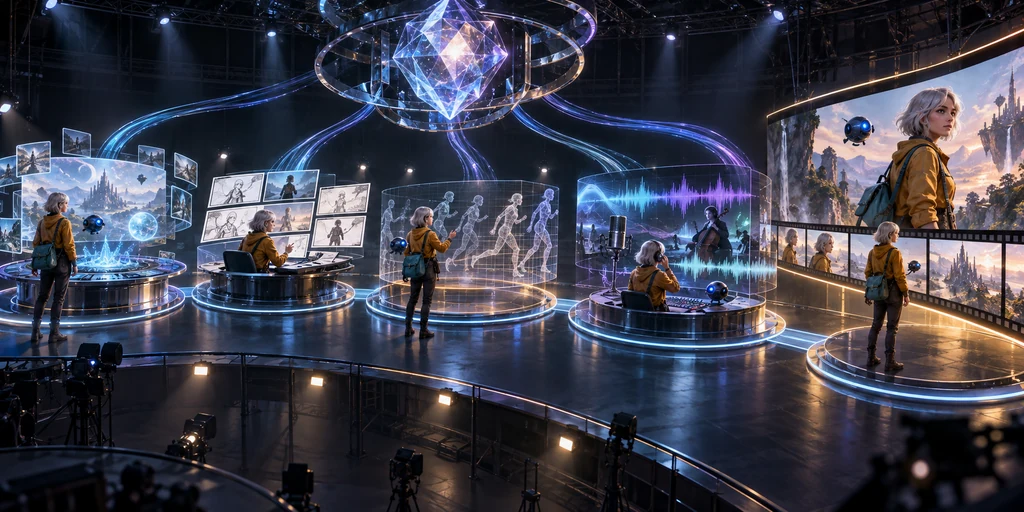
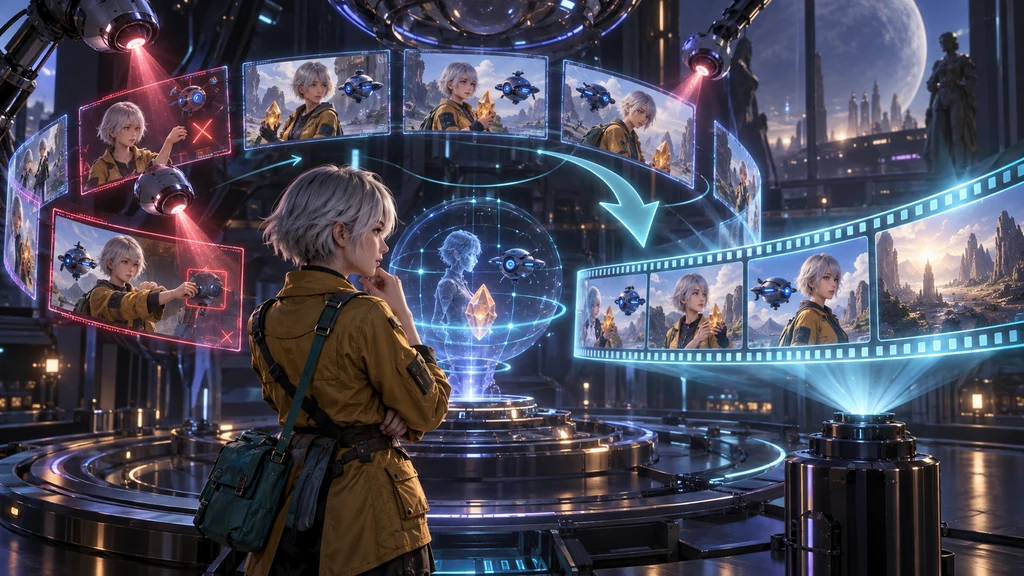
A²RD produces video segment by segment. It retrieves multimodal memory, synthesizes a segment, critiques it, and updates state. It can favor extrapolation when the story must advance and interpolation-like anchoring when an existing person or place returns.
The authors report improvements of up to 30% in consistency and 20% in narrative coherence across one- to ten-minute evaluations. Those figures belong to specific benchmarks and research settings. A production test should also measure model calls, regeneration cost, editing time, and the percentage of frames or shots corrected by people.
Evaluation should ask answerable questions, not emit one score
VQQA generates questions tailored to each video: Does a box-shaped balloon still look inflated? Does each musician keep the same instrument after a cut? Answers become human-readable directions for prompt refinement.
It also avoids automatically accepting the final iteration. A local repair may damage another attribute or the original intent, so a global rater compares every candidate with the initial prompt. The paper reports absolute gains of 11.57 percentage points on T2V-CompBench and 8.43 points on VBench2 over vanilla generation.
A minimum workflow creators can use today
The research systems may not be available as turnkey products, but their operating model is transferable.
- Freeze a one-page creative contract: audience, intent, narrative mode, visual tone, and exclusions.
- Maintain three ledgers: character identity, location geometry, and current prop state.
- Use only approved keyframes as anchors: never propagate the first output simply because it exists.
- Write shot prompts as deltas: specify only the action, camera, and state changes in this shot.
- Create question-based checks for every shot: face, costume, hands, props, axis, space, action outcome, and audio.
- Choose from the full candidate history: compare repaired clips with the original intent, not just the previous version.
| Artifact | Required content | Pass condition |
|---|---|---|
| Creative contract | Intent, narrative, aesthetics, exclusions | Every shot belongs to the same work |
| World-state ledger | Fixed and changing character, space, prop fields | State before and after a cut is explainable |
| Approved keyframes | Canonical face, costume, space, lighting | Trustworthy anchors for generation |
| Shot delta | Start state, action, end state, camera | One meaningful change per shot |
| Question-based QA | Yes/no questions plus evidence frames | Failure location and repair are specific |
What remains unresolved
This research is strong evidence that long-form generation is moving from a single prompt toward a production system. Public reports do not yet establish real-world cost, latency, failure rate, or editability. Benchmarks cannot stand in for subtle acting, cultural context, legal review, or audience judgment.
Creators must still verify likeness and voice rights, training and reference permissions, provenance disclosure, and platform policies. Google says the framework inherits SynthID through Gemini and Veo, but watermarking does not prove ownership or factual accuracy. Creative direction, anchor approval, and the final cut still need accountable human control.
Conclusion: the next contest is production memory, not clip length
The bottleneck is not generating a few more seconds. It is preserving the promise of the whole story, remembering the changing state of its world, and returning to the exact failure point for a targeted repair.
Future video tools may look less like one generate button and more like an operating system for direction, memory, evaluation, and version selection. The most useful preparation today is not a longer prompt. It is a creative contract, state ledgers, approved anchors, and answerable QA questions.
Primary sources
- Google Research: Automating coherent long-form video generation
- Co-Director: Agentic Generative Video Storytelling
- CANVAS: Continuity-Aware Narratives via Visual Agentic Storyboarding
- A²RD: Agentic Autoregressive Diffusion for Long Video Consistency
- VQQA: An Agentic Approach for Video Evaluation and Quality Improvement
Research findings and product behavior can change. Recheck the latest paper versions, service terms, provenance requirements, and rights policies before production use.