
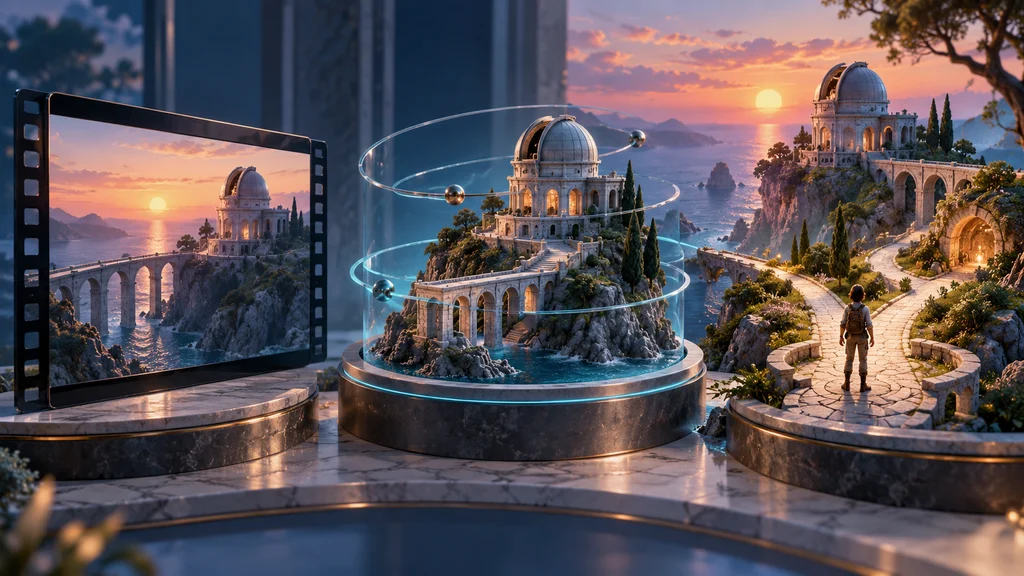
Imagine an AI-generated coastal city. In a video, the camera follows the route chosen for you. Now imagine taking the left staircase, walking behind the observatory, and deciding where to go next. Watching a scene becomes making choices inside a space.
That transition makes world models compelling. Yet an “AI world you can enter” can mean very different deliverables: continuously generated frames, a reusable 3D scene, or predictions about actions. Their production requirements differ just as much as their interfaces.
This is a technology insight based on official material checked on October 19, 2026, not a hands-on product ranking. The images are AIZIGOO-generated conceptual illustrations, not product screenshots or experimental results.
1. Start with the output: video, space, or action
The useful first question is what remains after the job finishes. Do you need pixels for an audience, a scene whose structure survives a camera change, or state and action data that software can inspect?
| Required output | What the user does | Main check |
|---|---|---|
| Finished video | Plays a planned sequence | Image quality and editability |
| Interactive generated frames | Steers movement or viewpoint | Latency and return consistency |
| Explicit 3D scene | Saves, renders, or edits a space | Format, scale, and hidden surfaces |
| State or action predictions | Changes conditions and evaluates outcomes | Dynamics and action validity |
World Labs proposed a functional distinction between observations, state, and actions in its June 2026 taxonomy. It is a vendor's framing rather than a universal standard, but asking about outputs is a useful habit. A single model may support several functions; the categories need not be rigid product tiers.
2. Genie: experience a world that responds to input
DeepMind's Genie documentation describes worlds that respond to user control. Project Genie is presented as an experimental research prototype, with limitations on available actions and sustained interaction. It is not presented as a perfectly accurate reconstruction of real places.
For a creator, the revealing test is what survives a return visit. Walk up the observatory stairs, look behind the dome, then return to the entrance. If doors, windows, railings, and floors remain coherent, you feel you have explored one place. If they change, impressive short sequences may still produce an unstable exploration experience.
Using this to explore a game concept is different from receiving a finished game. Persistence, scoring, enemy rules, collisions, reconnect behavior, multiplayer, and deployment formats each require verification. A controllable visual experience does not establish those capabilities by itself.

3. Marble and Atlas: treat space as a deliverable
World Labs' World API announcement describes generating explorable 3D environments with Marble from text, images, and video. Generation is asynchronous: submit a request and wait for a result. That asset-first workflow differs from generating each next frame during interaction.
Atlas, announced September 1, 2026, introduces spatial context with camera positions and explicit 3D outputs. The announcement describes select-partner early access and future use in Marble and other products. Do not assume every research capability is available in a current Marble account.
A convincing view and a production-ready space have different acceptance criteria. Gaussian splats represent appearance. Collision meshes, editable meshes, materials, and game logic are separate things to inspect. A smooth camera move does not prove that a floor height or stair collision is correct.
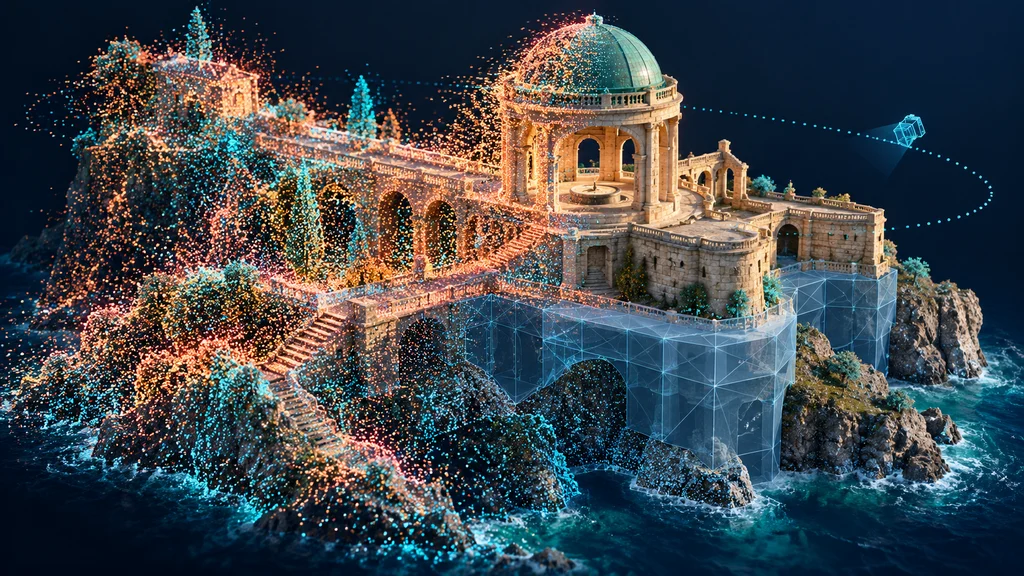
For film previs, finding a useful camera position may already deliver value. Moving the same scene into a game requires further checks for scale, collisions, memory, loading, and editability. The destination workflow determines whether an output is good enough.
4. Cosmos: rehearse possibilities before physical action
NVIDIA's May 31, 2026 Cosmos 3 announcement connects scene understanding, generation, and action data for physical AI. These are vendor-described capabilities; this article does not independently reproduce robot performance.
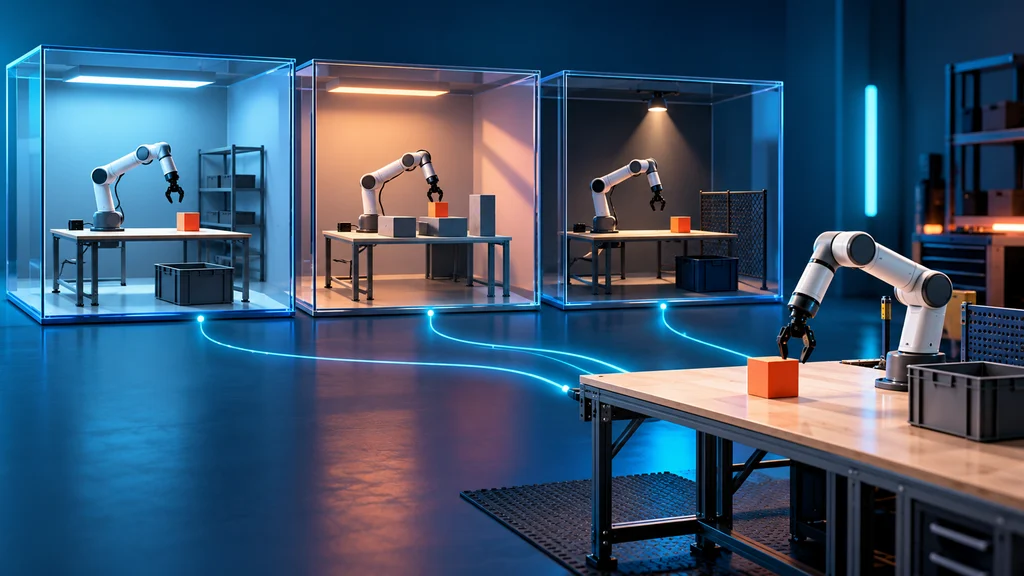
The practical question is whether conditions can be changed and tested. Consider a pick-and-place task with a box: vary its position, lighting, and obstacles while holding the objective constant. This can help reveal a policy that succeeds only in one arrangement. It is an illustrative use case, not a result measured by AIZIGOO on a particular service.
Success in a synthetic environment still needs real-world verification. Cameras, friction, mass, and sensor errors affect outcomes. A physically plausible video and validated control of actual equipment are different kinds of evidence.
5. Match the technology to the job
This table is an AIZIGOO decision aid, not a product ranking. Use it to check whether the input, deliverable, and downstream process match your goal.
| Goal | Investigate first | Downstream work |
|---|---|---|
| Finished ad or music-video shot | Video generation and editing | Selection, sound, and post-production |
| Explore a game-world concept | Input-responsive world generation | Rules, state, and reproducibility |
| Film-set and camera previs | 3D space and camera control | Blocking, viewpoints, and continuity |
| Virtual showroom | Exportable 3D scene | Scale, product fidelity, device performance |
| Robot training or evaluation data | Action-conditioned generation and simulation | Hardware and sensor validation |
If a thirty-second advertisement already has a fixed camera route, generating an entire world may add little. If customers must explore a showroom themselves, one finished video cannot satisfy the interaction requirement. Choose by how the result will be used.
6. A thirty-minute evaluation before adoption
The following is a suggested test protocol, not an official benchmark or a report of model results. Set a spending limit before paid generation, then use the same brief and route for each candidate.
- Fix the world contract. Record one entrance, three windows, the staircase position, accessible areas, and reference images for the observatory.
- Repeat a short route. Entrance, staircase, behind the dome, then back to the start. Save matched viewpoints.
- Inspect occluded surfaces. Separate regions observed in references from plausible regions invented by the system.
- Change one condition. Alter lighting or a box position and check whether fixed elements drift.
- Take the result out. Save or export in the required format and open it in another tool, browser, or device.

| Test | Evidence to keep | If it fails |
|---|---|---|
| Same place after returning? | Matched before-and-after views | Reconsider continuous exploration |
| Intended movement works? | Input and response record | Check action limits and latency |
| Save or export succeeds? | File and downstream view | Reconsider integration |
| Structure is appropriate? | Scale, floor, and wall checks | Restrict to visual reference |
| Cost per usable result? | Generation, retries, review time | Recalculate successful-output cost |
Do not stop at the price of one call. Record usable-output cost = generation + failed retries + review and cleanup + downstream corrections. With a small sample, use the evidence to choose the next failure class to investigate rather than declaring a universal winner.
What creators can prepare now
A clear spatial brief is more useful than an increasingly long prompt. Specify fixed layout, allowed movement, reference provenance, regions that may be imagined, output format, and acceptance checks. For a real location or product, record where the model filled gaps rather than reproducing observed information.
World models are bringing video, 3D, and simulation closer together. Choosing a tool still begins with a concrete requirement: a scene for an audience, a space for a person to explore, or state and actions for a machine to calculate.
Official sources checked
- Google DeepMind: Genie 3
- World Labs: A Functional Taxonomy of World Models, June 3, 2026
- World Labs: Announcing the World API, January 21, 2026
- World Labs: Atlas, September 1, 2026
- NVIDIA: Cosmos 3, May 31, 2026
Checked October 19, 2026. Confirm regional access, account and plan eligibility, export formats, and licensing in the relevant official service before use.