
An AI virtual idol group is not finished when four attractive images share a frame. Each member needs a memorable identity, the four must still read as one team, and the production must track the rights behind music, voices, choreography and video while communicating where synthetic media was used.
Virtual idol and AI idol are not synonyms. Some projects are performed by people through motion capture and 3D avatars; others use generative AI in only part of the pipeline. This guide builds a wholly original adult four-member concept with image and video tools. LUMINA FOUR and every member shown here are fictional and unrelated to any real performer or existing group.
Build the group bible before generating images
| System | Decision | LUMINA FOUR example |
|---|---|---|
| One-line promise | What fans should remember | Four different lights form one orbit |
| Member roles | Narrative role beyond vocal position | Leader, analyst, performer, storyteller |
| Identity anchors | Features that never change | Face, skin, eyes, hair, one member color |
| Shared grammar | What makes them a group | Graphite and pearl, asymmetric tailoring, orbital motif |
| Prohibitions | What production will not create | Real-person likeness, minors, unlicensed voice clones |
| Disclosure | What audiences must know | Virtual group, synthetic scenes, commercial relationships |
Approve one sentence per member, the visible anchors and the prohibitions before writing a long fictional universe. Re-describing everyone from scratch in every prompt encourages attribute swapping. A more stable order is member anchor sheet → group wardrobe system → scene keyframe.
Step 1: Lock all four members in an anchor sheet
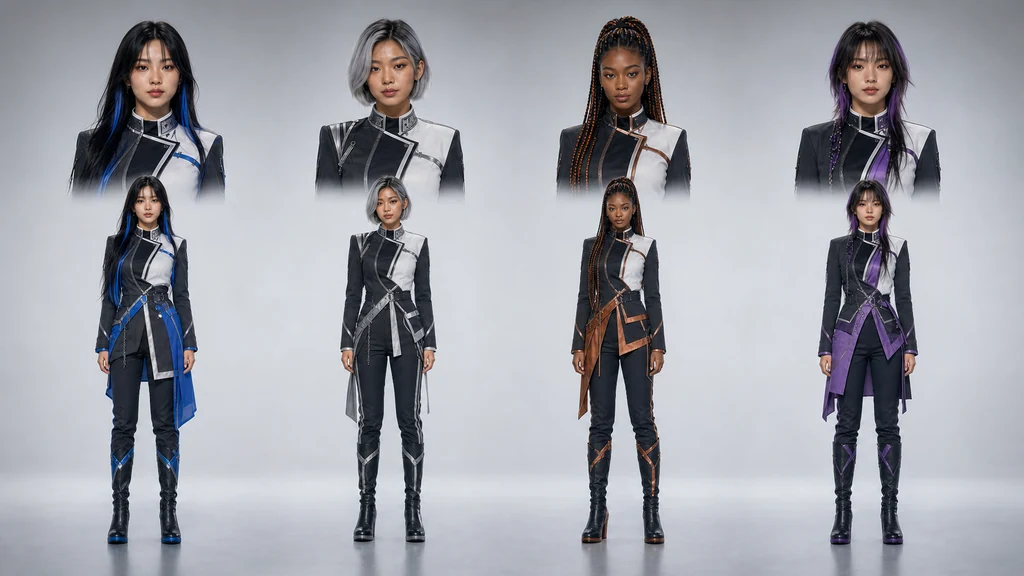
Do not jump from the first group portrait straight to video. Put full-body front views and large portraits on one sheet, then inspect face proportions, skin tone, hair and relative height. OpenAI's image prompting guide recommends assigning explicit roles to references, describing scene, subject, details and constraints clearly, and iterating with small controlled changes.
Production prompt
Use the approved four-member debut image as the identity anchor. Preserve the exact same four fictional adult women, face shapes, skin tones, eye colors, hairstyles, hair accents, relative heights, and left-to-right order. Create a wide 16:9 professional character anchor sheet in a clean pearl-grey virtual production studio. Show the four members separately with generous spacing, full body from head to boots, front-facing neutral A-pose. Above each figure include one large unlabeled head-and-shoulders portrait of the same member with a neutral expression. Use four clear vertical bays but no letters, names, numbers, logos, watermark, UI text, or fake typography. Maintain graphite-and-pearl futuristic stage tailoring and one controlled accent per member: electric blue, silver, copper, violet. Soft even studio key light, subtle rim light, 50mm perspective, accurate hands, coherent anatomy, sharply resolved faces and garments. Exactly four adults, no minors, no sexualized pose, no celebrity resemblance, no costume swapping, no duplicate people. Leave safe margins around heads and feet.The test is not merely whether the image is attractive, but whether you can reproduce the same people. Check whether facial landmarks, hair accents, relative height and personal colors survive three consecutive generations. Keep only approved anchors in the reference folder and version them.
| Check | Failure signal | Correction |
|---|---|---|
| Faces | Members converge or features bleed together | Freeze each face anchor in a separate sentence |
| Hair | Length or accent location changes | Repeat hair in the preserve constraints |
| Height | Order changes between scenes | State left-to-right order and relative height |
| Headcount | Fifth face or duplicated member appears | Specify exactly four adults and no extra people |
Step 2: Separate personal color from shared wardrobe grammar
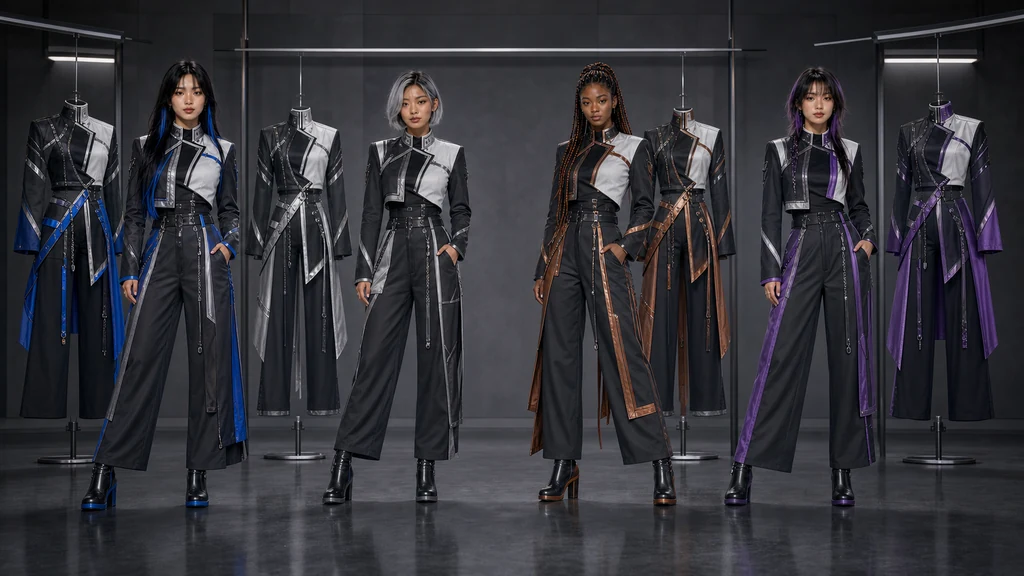
Four unrelated outfits look like four characters, while identical uniforms with recolors erase personality. Start with a rule such as 70% common silhouette, 20% member-specific cut or material, and 10% signature color, then compare everyone on one wardrobe board.
Production prompt
Use the approved debut image and member anchor sheet as strict references. Preserve exactly the same four fictional adult members, left-to-right order, faces, skin tones, hairstyles, relative heights, and signature accent colors: electric blue, silver, copper, violet. Create a wide 16:9 premium wardrobe and color-system concept board in a dark-grey fashion atelier. Place the four women in a straight line with full bodies visible. They wear a coordinated second-stage costume family: futuristic performance tailoring with asymmetric cropped jackets, high-neck fitted tops, structured wide-leg trousers and practical ankle boots. The group shares graphite, pearl and brushed-metal materials while each member retains only her own accent color. Add four adjacent mannequin torsos or suspended costume variants behind them, one per member, but no extra human figures. Premium fashion editorial realism, controlled softbox lighting, realistic textiles, accurate hands and anatomy. Exactly four adults, no text, logos, watermark, real-person resemblance, sexualized styling, color swapping, or hairstyle changes.When creating a new music-video look, keep faces and personal colors fixed and change only one or two variables. If physical performance is planned, a human team must still review joint range, footwear, quick changes and contrast on LED walls. A generated board aligns visual direction; it is not a construction-ready costume specification.
Step 3: Design readable formations, not just stylish poses
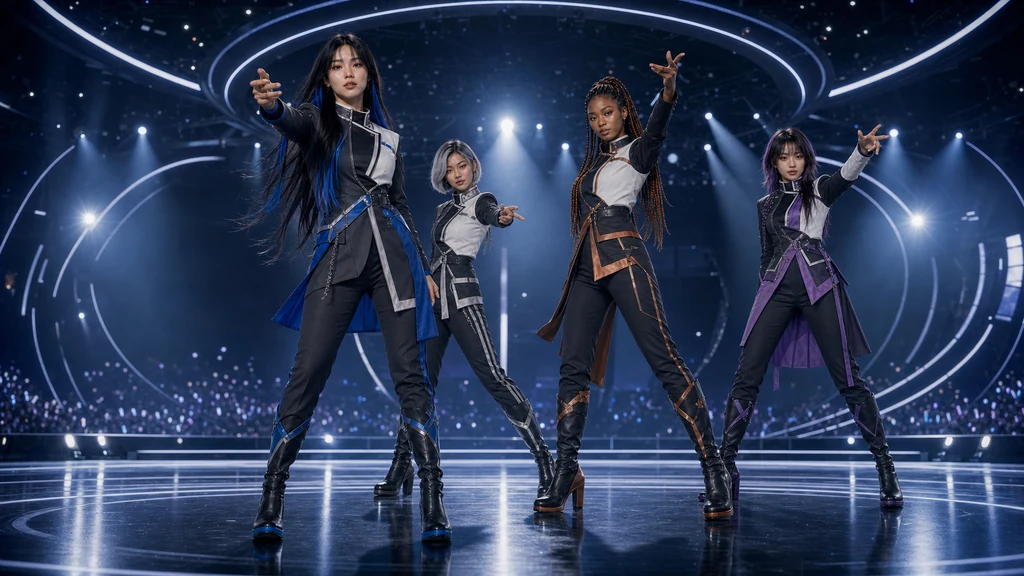
The video length belongs in the tool settings, not the prompt. Describe who moves, what movement happens, how the formation reads and how the camera moves. Several formation changes in one shot increase the risk of drifting faces and broken limbs.
Production prompt
Use the approved debut image, member anchor sheet, and wardrobe board as strict identity references. Preserve exactly the same four fictional adult women, faces, skin tones, hairstyles, relative heights, individual electric-blue, silver, copper and violet accents, and coordinated graphite-and-pearl performance wardrobe. Create a wide 16:9 cinematic live-stage choreography keyframe. All four performers are visible head to toe in one synchronized formation at the peak of a precise dance move: the blue-accent leader one step forward at center-left, silver and copper members forming a mirrored diagonal behind, violet member completing the right edge. Their movements are dynamic but anatomically plausible, with each face readable and body unobstructed. Futuristic circular arena, luminous orbital rings, cool blue-white spotlights, subtle haze, reflective black floor and abstract audience lights. Low wide master shot, 28mm lens, crisp faces, subtle motion energy only in fabric edges, premium concert realism. Exactly four adults, no extra dancers, no minors, no celebrity resemblance, no sexualized pose, no text, logos, watermark, identity drift or costume swapping.For image-to-video, add only the movement:
The four performers complete one synchronized arm sweep and settle into the shown formation. The blue-accent leader shifts one step forward while the others maintain the diagonal. Fabric edges respond naturally. The camera makes a slow stabilized push-in at waist height. Preserve all four faces, hairstyles, costumes, member colors and stage geometry. No cut, morphing, new dancer or camera whip.
Begin with one action, one expression change and one camera path. When choreographic accuracy matters, use blocking created by a human choreographer or properly licensed motion references, then confirm that the generated movement is physically performable.
Step 4: Write causality between music-video keyframes
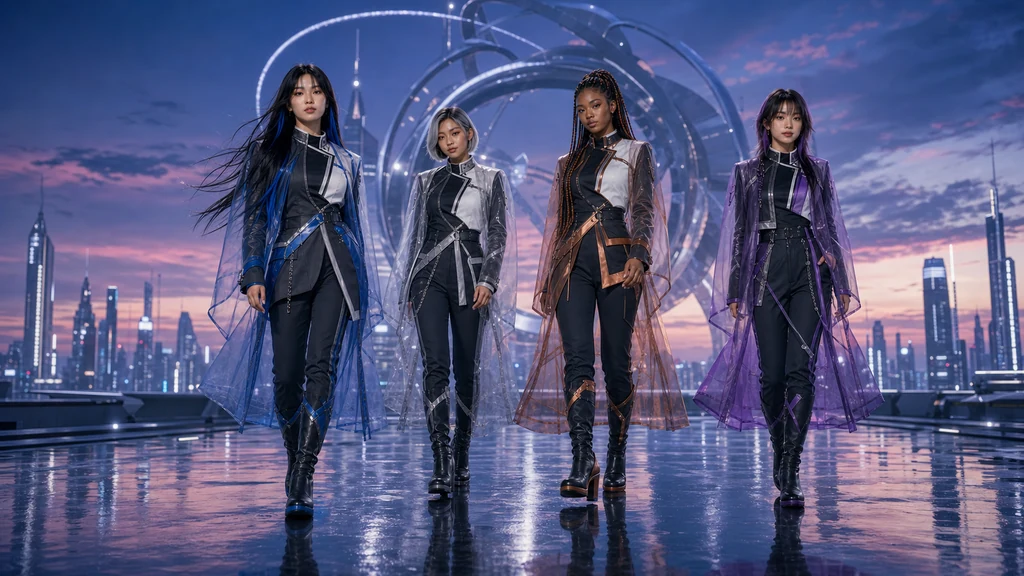
A strong video is more than a gallery of attractive shots. Define why one image leads to the next—for example, four lights in rehearsal become one orbit on stage and then rise over the city for the debut. Approve one keyframe for each act before animating it.
Production prompt
Use the approved group references as strict identity anchors. Preserve exactly the same four fictional adult members, face structures, skin tones, hairstyles, relative heights and signature colors—electric blue, silver, copper and violet. Maintain the coordinated graphite-and-pearl styling, adapted only with lightweight translucent outer layers. Create a wide 16:9 cinematic music-video keyframe at blue hour on a surreal rooftop observatory above a luminous future city. The four members walk slowly toward camera in a shallow arrow formation, calm and self-possessed, with natural synchronized stride and individually readable faces. A large translucent orbital sculpture arcs behind them; soft wind moves hair and fabric; a thin sheet of water reflects the group and violet-blue sky. Medium-wide tracking-shot composition, 35mm lens, camera at waist height, slight parallax, faces sharp, premium film color. Exactly four adults, no background performers, minors, real-person likeness, sexualized pose, text, logos, watermark, identity drift, color swaps, or distorted anatomy.OpenAI's video guide recommends specifying shot type, subject, action, setting and lighting, and explains how an input image can serve as the first frame. Character and reference restrictions and commercial terms differ by tool, so verify the current rules before production.
Track music, voice and performance rights separately
| Asset | Safer starting point | Record |
|---|---|---|
| Character | Original adult identity unlike a real person | Anchors, generation and edits, approver |
| Voice | Contracted performer or commercially permitted synthetic voice | Consent scope, term, revocation, training and cloning rights |
| Music | Original performance or explicitly licensed material | Lyric, composition, arrangement and vocal contributions |
| Choreography | Original or licensed choreography and motion | Choreographer, performer and motion-data terms |
| Video | Approved keyframes and human-edited cuts | Models, inputs, selection and editing history |
| Sponsorship | Real agreement and verifiable product facts | Material connection, approved claims and publication period |
Do not clone a real singer without permission or imply that an existing idol participated or endorsed the project. YouTube's AI disclosure is not permission to impersonate. Contracts with vocal performers should address transformation, model training, derivatives, territories, duration and end-of-contract handling.
The U.S. Copyright Office treats digital replicas and copyrightability in separate AI reports and emphasizes human creative contribution. The Korea Copyright Commission also publishes registration and dispute-prevention guidance. Record human work such as the group bible, lyrics, arrangement, choreography, selection, compositing and final editing by version; obtain jurisdiction-specific advice for a particular release.
Make disclosure part of the production specification
As checked on August 2, 2026, YouTube requires disclosure for meaningfully altered realistic scenes and includes synthetic music among its examples; TikTok requires labels for realistic AI images, audio and video. Policies change, so recheck them before upload.
- Clearly describe the act as a virtual group in the profile and official introduction.
- Use platform AI labels for realistic synthetic scenes, voices and music.
- Preserve C2PA Content Credentials when supported.
- Disclose sponsorships, free products and affiliate links near the claim; do not invent first-person product experience for a virtual member.
- Do not train on or synthesize fan faces, voices or artwork without separate permission.
A 30-day pilot
| Days | Deliverable | Gate |
|---|---|---|
| 1–5 | Group bible and four member anchors | Real-person similarity review; identity stable three times |
| 6–10 | Two wardrobe families and color rules | Team unity and personal colors both readable |
| 11–16 | Three formations and keyframes | Correct count, hands, feet, height and motion |
| 17–22 | Three-act board and test clips | Causality and face/costume continuity pass |
| 23–26 | Music, vocal and choreography rights ledger | Owner and permitted scope known for every asset |
| 27–30 | Teaser release and review | Zero missing AI or commercial disclosures |
Do not start with a full album. Pilot one 20–30 second scene, one chorus and one wardrobe family. Track face consistency, member recognition, revision time, unverified-rights count and audience confusion signals alongside views.
Conclusion
Creating an AI virtual idol group is a problem of repeatable identity and accountable production, not raw generation volume. Start with a group bible, lock member anchors and wardrobe grammar, then expand into stage and music-video scenes with one controlled action and camera path at a time. When voice, music and choreography rights are separately documented and synthetic media is transparently labeled, four generated characters can become one sustainable team.
Official sources reviewed
- OpenAI — Image generation prompting guide
- OpenAI — Video generation guide
- YouTube — Altered or synthetic content disclosure
- YouTube — Impersonation policy
- TikTok — AI-generated content labels
- C2PA — Content Credentials explainer
- U.S. Copyright Office — Copyright and Artificial Intelligence
- Korea Copyright Commission — Generative-AI copyright guidance
- KOCCA — AI content festival and virtual-idol examples
- FTC — Endorsements, Influencers, and Reviews
LUMINA FOUR, its members and all images are original fictional educational examples, unrelated to real people, idols or brands. This is not legal advice. Platform policies and tool terms may change after 2026-08-02.