
Many virtual-influencer projects begin with a beautiful face. One attractive portrait, however, is not an account. If the eye shape, age, personality, and voice change in every post, the audience notices generation errors rather than a coherent character.
A sustainable virtual influencer needs identity design, visual consistency, editorial rules, transparent disclosure, and a repeatable production workflow. This guide creates “Mira,” a fictional 26-year-old adult with no intended resemblance to a real person, then extends the same identity into a character sheet, lifestyle post, fictional brand collaboration, and video keyframe.
The first rule is transparency. A virtual person has no real product experience or professional credentials. Realistic synthetic media should use the relevant platform AI label, and any payment, free product, employment, or affiliate relationship should be disclosed clearly and conspicuously.
Six decisions before generation
| System | Decision | Mira example |
|---|---|---|
| Role | Who receives what value | Virtual creator explaining creative tools and design habits |
| Personality | Voice and prohibited claims | Calm and practical; no hype or false authority |
| Face anchor | Features that never change | Oval face, freckles, dark-brown eyes |
| Hair and palette | Repeated visual signal | Black bob with cobalt underlayer; cobalt, ivory, graphite |
| Content pillars | Repeatable topics | Process, tool reviews, city life, responsible partnerships |
| Disclosure | AI and commercial labels | Virtual-person note in profile and posts; sponsorship disclosed separately |
Do not begin with dozens of fictional biographical facts. Lock what appears on camera and the rules governing what the character may say. Lore can expand later; a drifting face or editorial voice can force you to rebuild the feed.
Step 1: Finish a character sheet before publishing the anchor
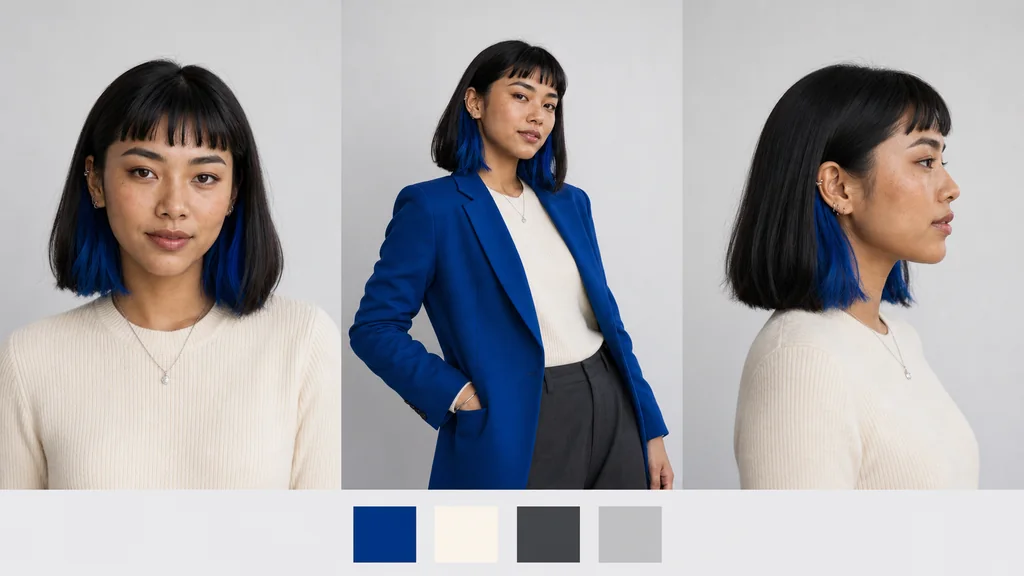
After choosing an anchor image, do not publish immediately. Use it to generate front, three-quarter, and profile views. That sheet becomes the reference for every subsequent asset. OpenAI's image guide recommends identifying the role of each reference and making small, targeted changes to preserve consistency.
Production prompt
Use case: identity-preserve. Image 1 is the only identity anchor for a completely fictional adult virtual influencer. Create a wide 16:9 professional character consistency sheet in a clean light-gray photography studio. Show the exact same adult woman from Image 1 in three clearly separated photographic views: front-facing head-and-shoulders, three-quarter waist-up, and right-side profile. Preserve the same oval face, warm light-medium skin and freckles, almond dark brown eyes, black shoulder-length bob with cobalt-blue underlayer, blunt micro-bangs, and left silver ear cuff. Keep her cobalt, ivory, graphite wardrobe palette; use a simple ivory top for face visibility. Natural neutral expressions with one subtle friendly smile, realistic skin texture, identical apparent age and facial proportions in all views. Add a small row of unlabelled cobalt, ivory, graphite, and silver color swatches at the bottom; no words. Even soft studio lighting, accurate anatomy. Constraints: do not redesign the person, do not change ethnicity, face, hair length, blue underlayer, age, or body proportions; adult only; no resemblance to real people; no logos, no readable text, no watermark, no extra people, no collage borders that cut faces.Judge the sheet by whether it is the same person, not whether each frame is individually beautiful:
- Do eye spacing, nose-to-mouth ratio and jawline survive all angles?
- Is the cobalt underlayer in the same area and the hair the same length?
- Are freckles, skin texture and the left ear cuff preserved?
- Does apparent age and body proportion remain stable?
- Are fingers, ears, teeth and jewelry anatomically credible?
Store only approved sheets in the reference folder. Do not reuse failed images as references; repeated errors quickly become accidental brand assets.
Step 2: Operate content pillars, not just a character
A virtual influencer still needs a reason to be followed. Replace an endless sequence of face swaps with three editorial pillars.
| Pillar | Weekly share | Examples | Quality question |
|---|---|---|---|
| Knowledge and process | 40% | Work notes, tool comparisons, before/after | Does the audience gain something useful? |
| Lifestyle and world | 35% | Cafe, city walk, workspace | Does the setting support the established voice? |
| Participation and partnerships | 25% | Questions, polls, ads, affiliate posts | Are AI and commercial relationships obvious? |
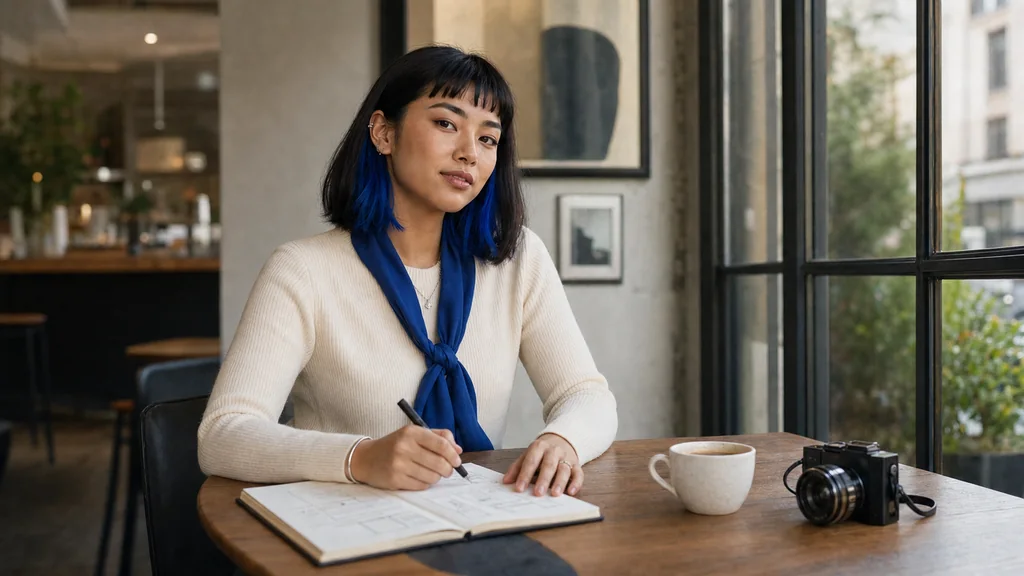
Production prompt
Use case: identity-preserve. Image 1 is the primary identity anchor and Image 2 is the approved character sheet. Create a wide 16:9 photorealistic lifestyle post featuring the exact same fictional adult virtual influencer. Scene: quiet design-district cafe in the morning, large window, warm wood table, ceramic coffee cup, open sketchbook and compact camera, no brands. She sits naturally by the window, looking down while drawing a simple content plan, then glances toward camera with a small genuine smile. Outfit: ivory knit top, graphite trousers, cobalt-blue lightweight scarf tied loosely at the neck, same minimal silver jewelry and left ear cuff. Preserve the exact oval face, freckles, dark brown almond eyes, black shoulder-length bob, cobalt-blue underlayer, micro-bangs, adult age, skin tone and proportions. Editorial lifestyle photography, medium-wide horizontal composition, natural window light, realistic skin texture and hands, subtle film grain, calm accessible mood. Constraints: do not redesign her; no change to identity or hair; no sexualized pose or revealing clothing; no readable text in the notebook; no logo, trademark, watermark, extra fingers, or extra people in focus.The prompt does not reinvent the face. It names the anchor and character sheet, then separates changeable scene elements from locked identity elements. Change the location, action, and one wardrobe component while locking face, hair, age, skin, and signature accessory.
Avoid captions that fabricate personal experience. “Here is how this composition was produced” can be verified by the production team. “I visited this cafe yesterday” or “this cream changed my skin after a week” presents a fictional experience as real.
Step 3: Approve the claim before producing a partnership
Virtual creators can prototype products and palettes quickly, but they can also turn nonexistent use into a convincing testimonial. The FTC's revised Endorsement Guides explicitly cover virtual influencers within truth-in-advertising principles and require material relationships—payment, free goods, employment, or affiliate links—to be disclosed clearly and conspicuously.
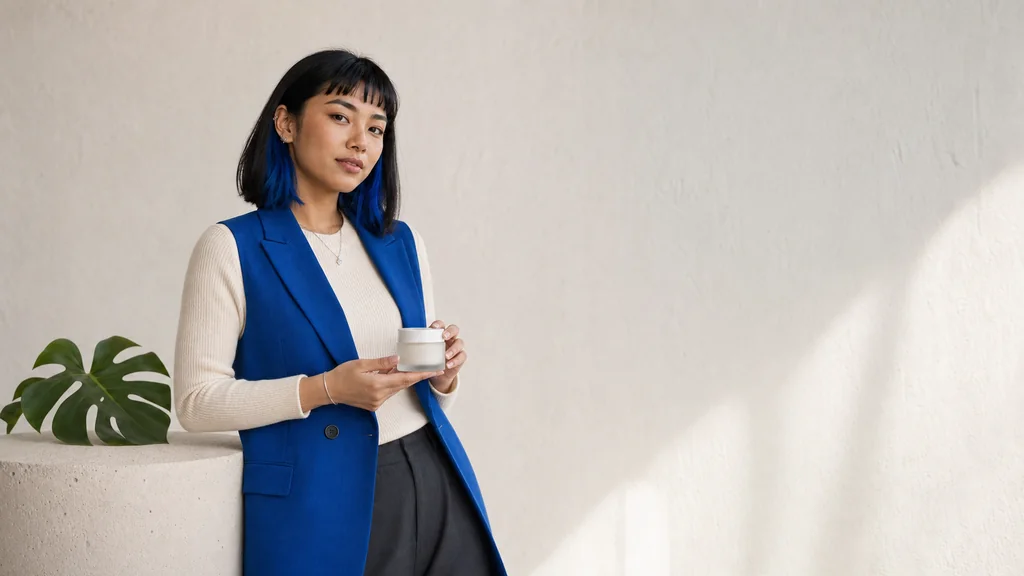
Production prompt
Use case: ads-marketing with identity preservation. Image 1 is the primary identity anchor and Image 2 is the approved character sheet. Create a wide 16:9 fictional campaign key visual featuring the exact same adult virtual influencer for a generic sustainable skincare concept. Scene: bright minimal studio with textured ivory plaster, a small stone pedestal, one unbranded frosted-glass moisturizer jar and a green leaf. The woman stands beside the pedestal, holding the unbranded jar at chest height in a natural informative pose, looking at camera with a calm trustworthy expression. Outfit: tailored cobalt-blue sleeveless long vest layered over an ivory long-sleeve knit and graphite trousers; modest, contemporary, no logos. Preserve exactly the same face, freckles, dark brown eyes, black bob with cobalt-blue underlayer, micro-bangs, left silver ear cuff, adult age, skin tone and proportions. Premium editorial product photography, landscape composition, soft diffused daylight, realistic skin, glass and fabric textures, subtle cobalt accent shadow. Leave clean negative space on the right but include no text. Constraints: fictional generic product only; no health claims; no endorsement text; no brand, label, trademark, watermark, sexualized pose, revealing clothing, identity drift, extra fingers or distorted hands.Use a pre-publication approval gate:
| Check | Question |
|---|---|
| Facts | Were product specifications and prices checked against official material? |
| Experience | Does the post avoid fictional first-person product results? |
| Advertising | Is the relationship visible near the claim and in platform tools? |
| AI identity | Can viewers tell the person is synthetic? |
| Rights | Are likeness, trademark, location and music rights cleared? |
| Approval | Did both operator and brand approve visual, copy, claim, and link? |
A platform's paid-partnership switch may not be sufficient in every jurisdiction or context. State the relationship in the content itself, and never make the virtual persona an expert witness on health, finance, or safety.
Step 4: Begin video from an approved keyframe
Starting every clip from fresh text generation increases identity drift. Begin with an approved image and prompt action, gaze, clothing response, camera path, and environmental motion rather than redescribing the person. Select duration in the video tool's settings instead of embedding it in the prompt.
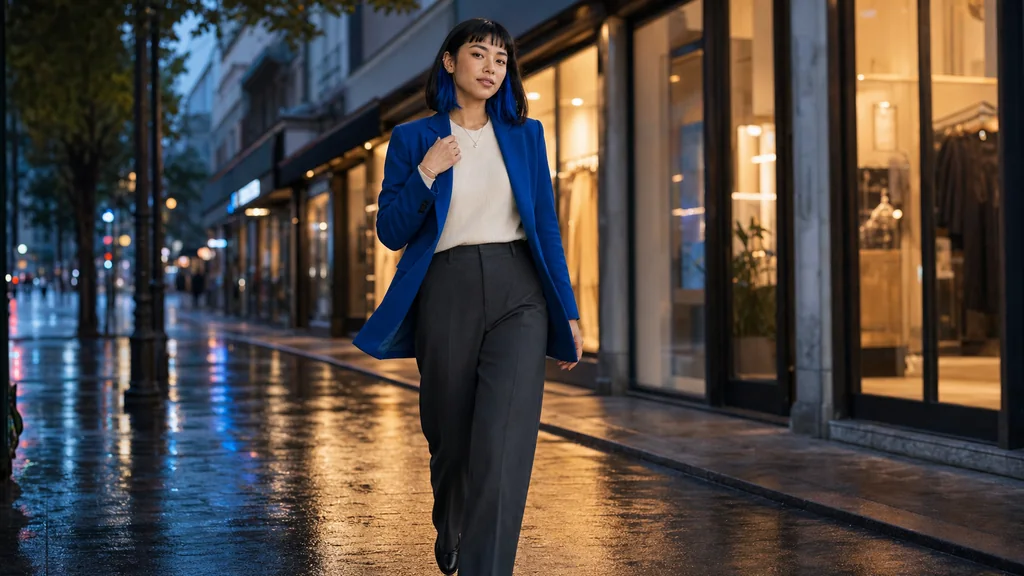
Production prompt
Use case: identity-preserve. Image 1 is the primary identity anchor and Image 2 is the approved character sheet. Create a wide 16:9 cinematic keyframe for a short social video featuring the exact same fictional adult virtual influencer. Scene: contemporary pedestrian street just after blue hour rain, wet pavement reflecting cobalt and warm shop-window light, generic storefronts without readable signs. Action: she walks toward camera at a relaxed pace, one hand lightly adjusting the lapel of her cobalt-blue jacket, hair and blue underlayer moving subtly in a breeze, confident but approachable expression, direct eye line. Outfit: same cobalt tailored jacket, ivory knit top, graphite wide-leg trousers, minimal silver jewelry and left ear cuff. Preserve exactly the same oval face, freckles, almond dark brown eyes, black shoulder-length bob, blue underlayer, micro-bangs, adult age, skin tone and proportions. Cinematic realistic photography, medium full-body landscape framing, 35mm lens feel, low stabilized tracking-camera perspective, natural motion in coat hem, shallow depth of field, authentic wet-street reflections. Constraints: do not redesign the character; no identity drift; no crowd faces in focus; no sexualized pose, revealing clothing, logos, readable text, watermark, duplicated body parts, distorted hands or feet.For image-to-video, add motion only:
She walks toward the camera at a relaxed pace. Her jacket hem and cobalt hair underlayer move gently in the breeze. She keeps a calm direct gaze, then gives one subtle smile. The camera tracks backward smoothly at waist height; wet reflections drift beneath her steps. Preserve face, body, outfit and background identity. No scene cut, no morphing, no new people entering the foreground.
One primary action, one expression change, and one camera path per shot are easier to stabilize. If the face drifts, reduce motion rather than expanding the prompt, and approve both the first and last frame.
Turn disclosure into an operating rule
As of July 2026, TikTok requires labels for realistic AI-generated image, audio, and video; YouTube requires disclosure for meaningfully altered or synthetic scenes that appear realistic. Meta uses detected signals and self-disclosure for AI information and has expanded ad transparency. Policies change, so check the current upload guidance before every campaign.
| Situation | Minimum operating rule |
|---|---|
| Realistic virtual-person image | Platform AI label plus virtual-person profile disclosure |
| Image-to-video or synthetic voice | Confirm synthetic-media setting at upload |
| Paid, gifted, employment, affiliate link | Clear relationship disclosure near the endorsement |
| Real person or customer reference | Document permission, scope, duration, and revocation process |
| Sensitive subject | Never present the persona as an expert or eyewitness |
C2PA Content Credentials can attach signed provenance and edit history to an asset. Preserve them when supported, but do not treat provenance metadata as a replacement for an ad disclosure or platform label.
A 30-day launch plan
| Period | Work | Passing condition |
|---|---|---|
| Days 1–3 | Define role, voice, prohibited claims, and palette | One-line promise and six locked traits |
| Days 4–7 | Generate anchors and three-view sheet | At least 8 of 10 images judged the same identity |
| Days 8–14 | Draft three posts per pillar | Knowledge, lifestyle, and participation represented |
| Days 15–21 | Approve caption tone and disclosure templates | Two-person editorial review is possible |
| Days 22–27 | Produce and schedule two weeks | Face, palette, voice checklist passed |
| Days 28–30 | Small launch and analysis | Saves, substantive comments, exits, and errors recorded |
Track save rate, meaningful comments, identity-error rate, editing time per post, and missing disclosures—not followers alone. Human-approved semi-automation is safer than unattended bulk publishing during the first month.
Conclusion
Creating an AI virtual female influencer is not primarily a face-generation task. It is an operating system that connects an original adult identity, approved references, useful content pillars, stable visual anchors, and transparent AI and commercial disclosure.
Start with one character and three pillars for 30 days. When trust and editorial standards accumulate—not just images—the virtual influencer becomes a durable media asset rather than a one-off render.
Official sources checked
- OpenAI Academy — Image generation and references
- FTC — Endorsements, Influencers, and Reviews
- FTC — Endorsement Guides Q&A
- TikTok — AI-generated content labels
- YouTube — Altered or synthetic content disclosure
- Meta — GenAI transparency for ads
- C2PA — Content Credentials explainer
Every person and product in this article is a fictional AI-generated example with no connection to a real person or brand. This is not legal advice; platform rules and local advertising or likeness laws may change after 2026-07-29.