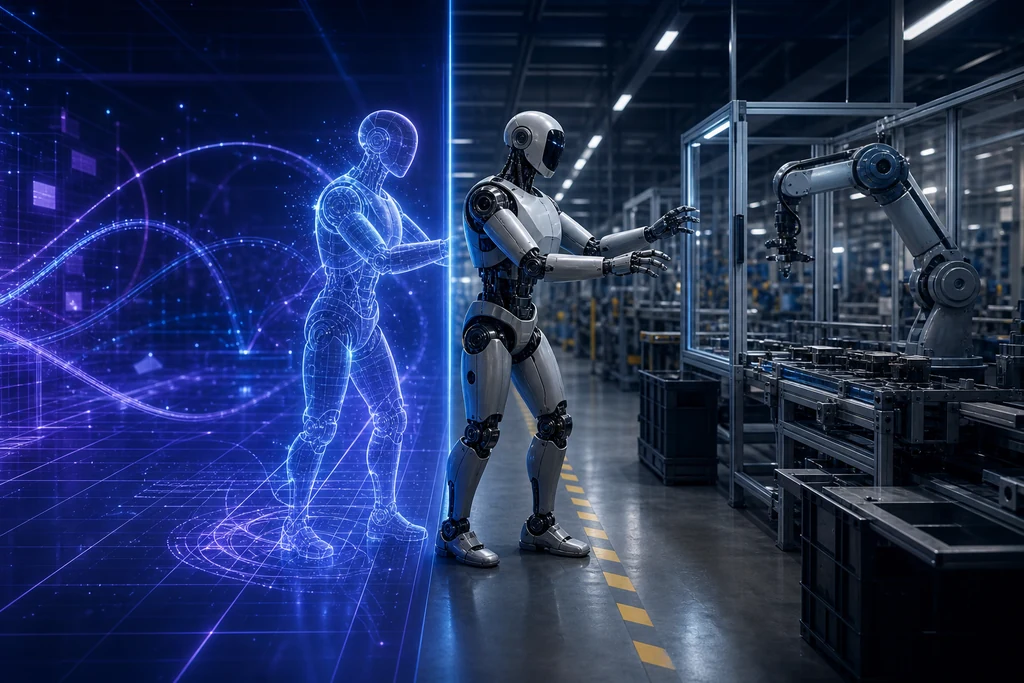
Telling a robot to pick up a cup is easy. Making it understand the cup's location and weight, a slippery surface, a hidden handle, camera angles, lighting, and the safest way to complete the motion is a different problem. Language models could learn from internet-scale text. Robots cannot collect embodied experience at the same scale.
That is why the center of the Physical AI race in 2026 is moving away from one bigger model and toward an entire learning loop. Human motion must become data. Simulation must create thousands of variations. A system must reason about space, act through a machine, and turn failures back into new training evidence.
Recent announcements reveal that loop. On July 21, 2026, Hugging Face and Pollen Robotics released Grabette, an open system that turns hand-operated demonstrations into robot-learning data. At SIGGRAPH 2026, NVIDIA presented research that applies related motion representations to virtual characters and physical humanoids, alongside world models designed for edge deployment. Google DeepMind's Gemini Robotics-ER 1.6 combines multiple camera views to decide whether a task is complete and can interpret analog instruments. ABB is piloting a workflow that trains industrial robots in digital twins before moving them onto production lines.
These are not parts of one robot product. They occupy different stages of the same pipeline: data → simulation → reasoning → action → validation.
Stage 1: Turn human motion into robot data
The first bottleneck in robot learning is often data, not model architecture. A warehouse, kitchen, and factory each require different manipulation examples. Teleoperating a real robot can produce accurate data, but it requires hardware and skilled operators and is difficult to repeat across many locations.
Grabette takes a simpler route. A person holds a portable gripper fitted with cameras and sensors, then demonstrates a task such as moving a cup or opening a drawer. Two cameras, an IMU, and gripper state are recorded on one timeline. A SLAM pipeline reconstructs the six-degree-of-freedom trajectory and converts the result into a standard LeRobot dataset. According to the published design, the handheld unit has a bill of materials of roughly €490, while the corresponding gripper attached to a robot arm costs roughly €120.
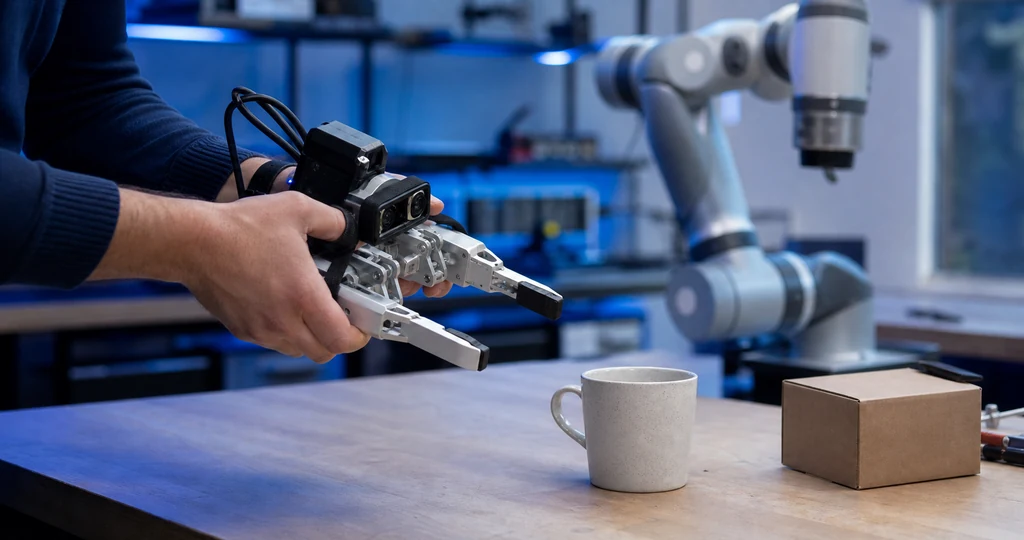
The important shift is that useful demonstrations can be collected without operating a robot during capture. In the published example, 200 cup-grasp demonstrations were used to train a policy that was then run on a physical arm. This does not prove generalization to every object or setting. It shows how the entrance to data collection can move beyond expensive robot labs.
More data is not automatically better data. Tracking loss, occluded hands, failed demonstrations, and narrow environments can teach the wrong lesson. The durable asset will be a dataset that also records how it was captured, how success was judged, which force and contact signals were available, and which abnormal situations should be separated from normal behavior.
Stage 2: Multiply rare situations in virtual worlds
Real-world data cannot efficiently cover every long-tail condition. Recreating unexpected stacking, dim lighting, altered friction, or dangerous collisions thousands of times in a factory is slow and unsafe. Digital twins and synthetic data expand the training space before a physical machine is exposed to those conditions.
Simulation can repeat one task while changing camera position, material, lighting, obstacles, and physical parameters. The goal is to let the robot fail virtually before it fails in the workplace. NVIDIA's SIGGRAPH 2026 material described research for simulating difficult substances such as snow, sand, and elastic solids. It also introduced MotionBricks, trained on more than 350,000 motion clips. The same motion representation driving a screen character and a physical humanoid illustrates how graphics research and robot learning are converging.
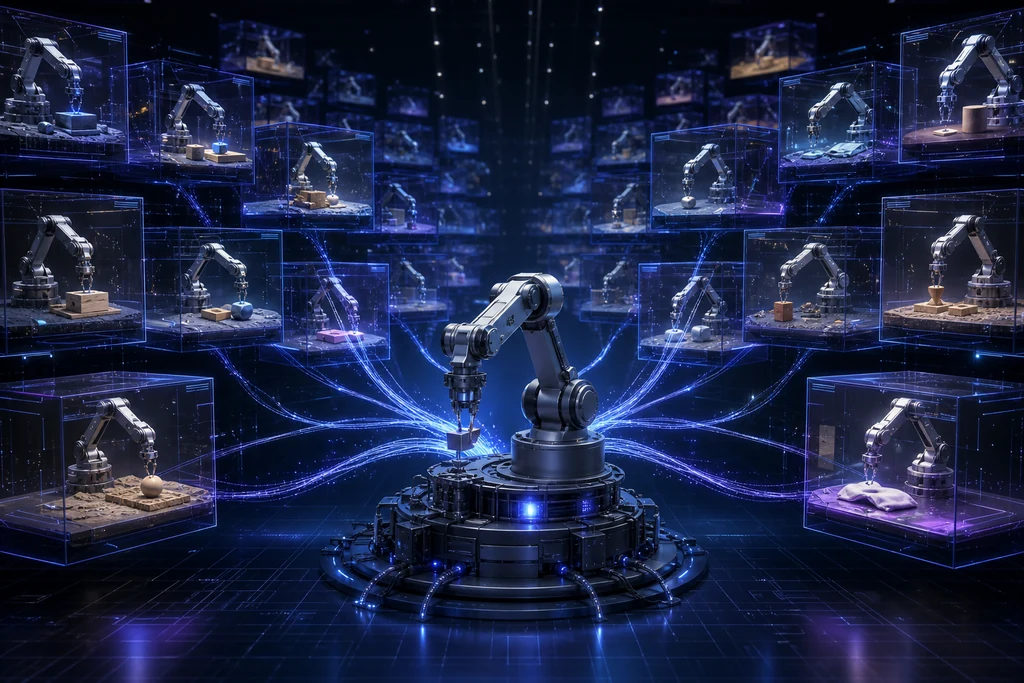
World models matter at this stage because they try to predict how a scene will change after an action, rather than merely classify what is visible now. NVIDIA describes Cosmos 3 Edge as a four-billion-parameter model designed to work with text, images, video, ambient sound, and action, with the aim of bringing physical-world understanding and robot policies onto edge hardware.
Synthetic data is not a replacement for reality. Unknown friction, sensor noise, cable deformation, and unpredictable human motion will not appear in a simulator that does not model them. A stronger loop starts with real measurements, expands them through virtual variation, and then recalibrates the simulation with deployment results.
Stage 3: See, point, and decide when the job is done
Data and simulation are not enough. A robot must understand the current scene, divide a natural-language goal into actions, reconcile several camera views, select a grasp point, and determine whether the work actually finished. This is embodied reasoning: spatial and physical reasoning for a system that can act.
Gemini Robotics-ER 1.6 is better understood as a high-level reasoning layer than as a single motor-control brain. It can represent object locations with points, reason about trajectories and grasp locations, and call a vision-language-action model or another tool. Google DeepMind also emphasizes multi-view success detection, such as deciding whether a pen seen from overhead and wrist cameras is truly inside its holder.
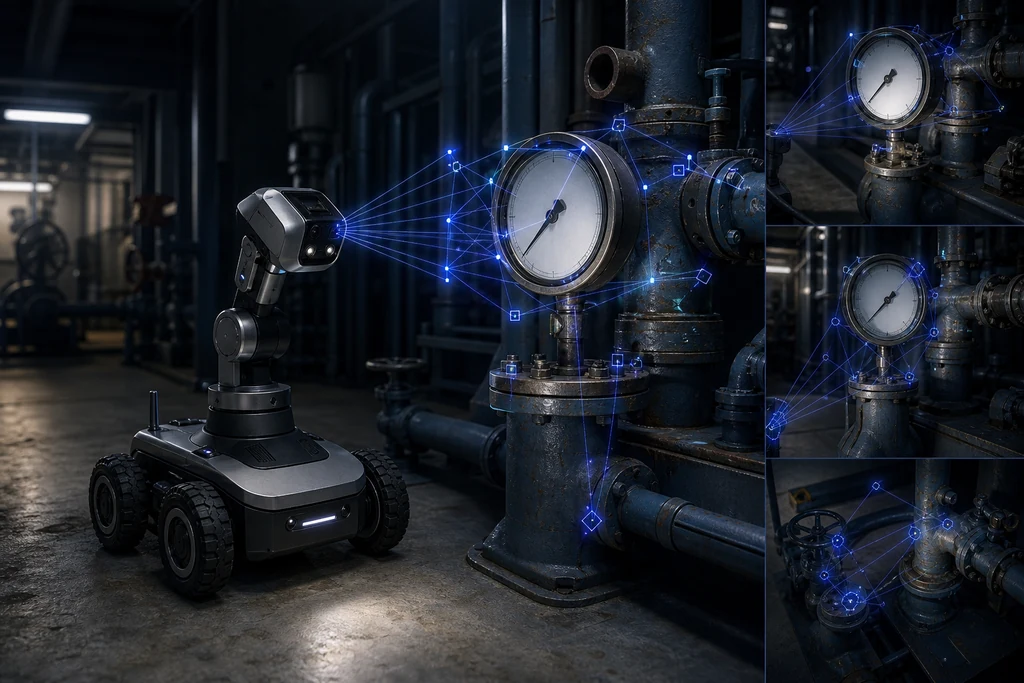
Instrument reading is a practical example. Industrial sites contain pressure gauges, sight glasses, and digital indicators. A model must distinguish a needle from markings, correct for perspective, and calculate a reading through several intermediate steps. In Google DeepMind's own evaluation, Robotics-ER 1.6 with agentic vision reached a 93% success rate on its instrument-reading task. That is a vendor-run benchmark, not a guarantee across all facilities.
The model card carries the more important warning. Google asks users to exercise discretion in production, commercial, and public environments and says the model should not be used for safety-critical applications such as healthcare or transportation where a malfunction could cause injury, death, or property damage. Better reasoning scores do not remove the need for independent safety systems and accountable people.
Stage 4: Move a learned behavior from simulation to a machine
A robot that succeeds in simulation may still fail in reality. Small differences in lenses, motor latency, component tolerances, friction, and vibration accumulate. This is the sim-to-real gap.
ABB's RobotStudio HyperReality combines NVIDIA Omniverse-based simulation with a virtual controller running the same firmware used by its physical robots. ABB reports up to 99% correlation from virtual training to deployment in a Foxconn electronics-assembly pilot and also publishes estimates for setup and cost reduction. These figures are claims tied to ABB's product and selected pilots; they should not be treated as independent, universal performance numbers for every factory or task.
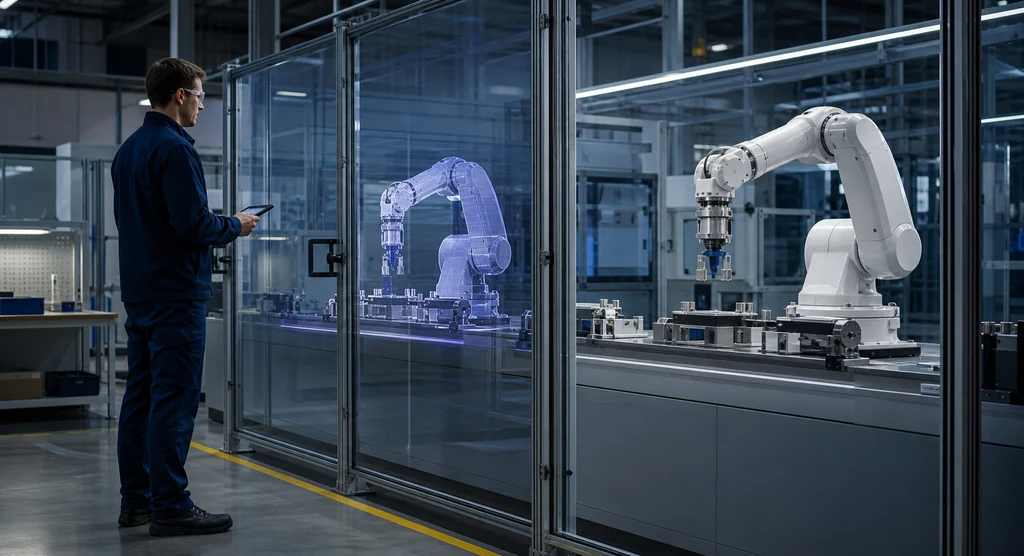
Practical validation is less about celebrating an average score and more about finding the edge of failure.
- Begin at reduced speed and force in an isolated cell.
- Deliberately vary object position, lighting, and friction.
- Inject sensor loss, latency, and communication failure.
- Verify the conditions that force a safe stop and human handoff.
- Turn real failures into reproducible simulation cases.
A robot's ability to stop safely and preserve evidence after failure matters more than a single successful demonstration.
Stage 5: Return every action to the learning loop
The lasting asset in Physical AI is not one model. It is a closed loop:
Human demonstration → real data → virtual variation → spatial reasoning → robot action → safety evaluation → new data
The faster this loop runs, the less it costs to adapt to a new object or environment. If each stage is trapped in a different vendor format, data cannot move and failures become hard to attribute to the model, sensor, or controller. Grabette's use of the standard LeRobot format, industry adoption of OpenUSD-based twins, and models that expose tool interfaces all point toward lower connection costs.
Eight questions to ask before adopting Physical AI
- Job boundary: Can the repetitive task be defined in one sentence?
- Data rights: Do you have permission to use recordings of workers, sites, and products?
- Failure data: Are unsuccessful and interrupted attempts captured alongside success?
- Simulation gap: Which physical conditions exist only in the real environment?
- Success detection: Is the robot's own completion judgment checked by an independent signal?
- Safety boundary: Are speed, force, workspace, and human-access rules enforced outside the model?
- Recovery: Can the system return to a safe state after bad action or lost communication?
- Regression: Are old tasks retested when the model, camera, or gripper changes?
The robot “ChatGPT moment” will not come from one model
The image of a general robot suddenly appearing in every home and factory is compelling, but progress is happening in quieter infrastructure: cheaper demonstration capture, richer simulated failure, multi-view completion checks, and disciplined validation before deployment.
The important change in 2026 is not a declaration that robots now think like people. It is that an industrial method is taking shape for turning reality into data, data into action, and the consequences of action back into learning.
The strongest Physical AI team may not be the one with the largest model. It may be the team that finds the difference between simulation and reality fastest, collects failure most safely, and reuses that experience in the next deployment.
Official sources
- Hugging Face and Pollen Robotics: Grabette open robot-manipulation data system
- NVIDIA: World models, MotionBricks, and Physical AI at SIGGRAPH 2026
- NVIDIA: Robotics research from simulation to the real world
- Google DeepMind: Gemini Robotics-ER 1.6
- Google DeepMind: Gemini Robotics-ER 1.6 model card and limitations
- ABB: RobotStudio HyperReality and the Foxconn pilot
Performance and cost-reduction figures are based on evaluations or cases published by the respective companies. Results can vary with robots, sensors, environments, and safety controls, so independent on-site validation remains necessary.